

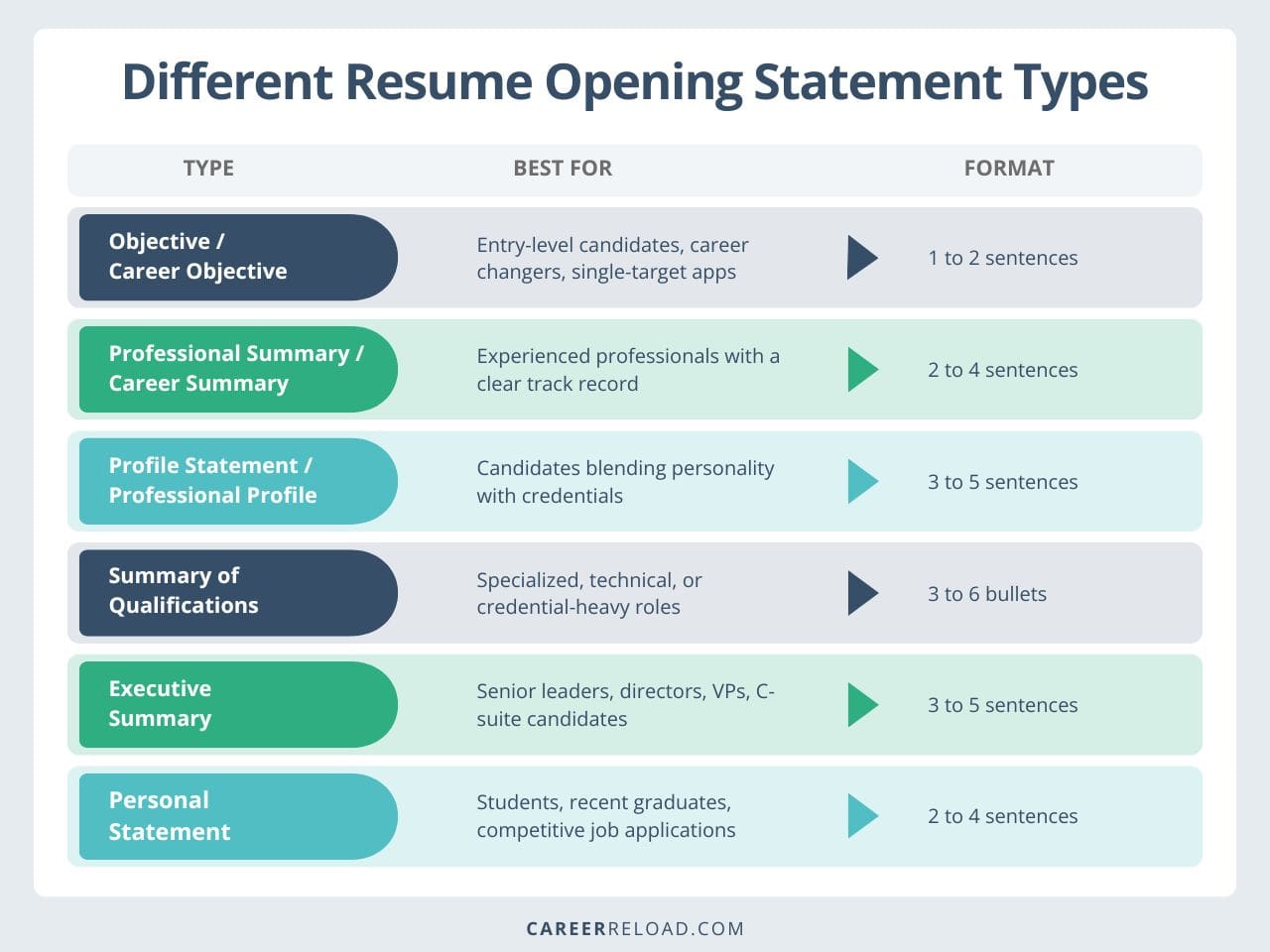
A resume objective is a one to two sentence statement at the top of your resume that names the role you want, the value you bring, and how your background fits the job. It works best for recent graduates, career changers, people returning to work after a gap, and anyone whose work history doesn’t make their target role obvious at a glance. Done right, an objective statement gives the recruiter a reason to read the rest of the page.
The objective has fallen out of fashion in some circles, replaced by the resume summary. That’s a fair preference for people with years of directly relevant experience. For everyone else, a sharp resume objective is still one of the most useful 30 seconds of writing you’ll do during a job search.
You might also want to read:
- Resume Summary vs Objective – What’s The Difference
- How to Write a Resume Personal Statement (With Examples)
- 8 Resume Opening Statement Types and How to Use Them
What is a resume objective?
A resume objective is a short statement, usually one or two sentences, that sits at the top of your resume and says who you are professionally, what you want, and what you bring. It is sometimes called a career objective or objective statement. The format is brief by design. Hiring managers spend only a few seconds on a first scan of any resume, so the words at the top do most of the work.
A strong objective answers three questions in plain language. What role are you applying for? What skills or experience make you a fit? What do you want to do for the employer, not just for yourself?
When to use a resume objective
A resume objective earns its place when your work history doesn’t already tell the story. That happens more often than people think.
You’re a recent graduate or first-time job seeker. The objective explains where you want to go since the resume below it can only show where you’ve been so far. You’re changing careers. The objective bridges the gap between what your previous roles look like and what you’re applying for now. You’re returning to work after a gap. The objective sets context for the time away without making it the headline. You’re relocating to a new city or state. The objective signals you’re serious about the move so a hiring manager doesn’t disqualify you over an out-of-state ZIP code. You’re applying for an internship. The objective makes your goals and learning interests clear when there isn’t much experience yet to list.
If your work history clearly matches the job you’re applying for, a resume summary usually serves you better. The two formats aren’t interchangeable. Pick the one that fits where you are in your career, not the one that feels safer.
How to write an impactful resume objective
Five rules cover almost every situation. Follow them and your objective will outperform 80% of the ones a hiring manager sees in a given week.
Lead with what you bring, not what you want
The biggest miss in a resume objective is making it about the candidate’s wants. “Seeking a challenging role that will allow me to grow.” Hiring managers don’t hire for that. They hire to solve a problem. Open with the value you offer, then connect it to the role.
Weak. Seeking a position where I can grow my marketing skills. Strong. Detail-oriented marketing graduate with internship experience in content strategy and SEO, looking to bring measurable campaign results to a B2B SaaS team.
Match the keywords in the job description
Most resumes pass through an applicant tracking system (ATS) before a human sees them. The system scans for specific terms from the job description, including hard skills, certifications, and job titles. Pull two or three of the most relevant ones from the listing and work them into the objective. Don’t keyword-stuff. One naturally placed term beats five awkward ones.
Be specific about the role and the value
Specificity is the difference between an objective that gets read and one that gets skimmed. Name the role exactly. Name the skill exactly. Name the result you’ve already delivered if you have one. “Improved checkout conversion 18% during a six-month internship” lands harder than “passionate about e-commerce.”
Keep it to one or two sentences
Three sentences is too many. The objective is a hook, not a paragraph. If you can’t say it in 30 to 50 words, you’re trying to do the work the rest of the resume should do.
Write in the third person and skip the pronouns
Drop the “I,” “me,” and “my.” Resume convention treats the objective as an implied first-person statement without the pronouns. “Recent finance graduate with two internships at mid-size advisory firms” reads cleaner than “I am a recent finance graduate.”
Resume objective examples by situation
Use these as a starting point. Then rewrite them to match your background and the job you’re applying for. A copy-paste objective rarely beats one tailored to the listing.
Recent graduate or entry-level
Recent business administration graduate with internship experience in supply chain coordination, seeking an entry-level operations analyst role to apply data analysis skills and process improvement experience.
Computer science graduate with hands-on projects in Python and React, looking to join a junior software engineer team where I can contribute to product features and grow under senior mentorship.
Marketing graduate with a 3.8 GPA and two semesters of social media management for the campus athletics department, applying for the digital marketing coordinator role at a growth-stage consumer brand.
Career change
Customer service manager with eight years of team leadership and operations experience, transitioning into project management and bringing proven skills in stakeholder communication, scheduling, and process improvement.
Former classroom teacher with seven years of curriculum design experience, pivoting to instructional design at a corporate L&D team and bringing strong assessment design and adult-learner facilitation skills.
Registered nurse with five years of patient care and clinical coordination experience, moving into healthcare consulting and offering deep operational knowledge of acute care workflows.
Returning to work after a gap
Experienced HR generalist returning to the workforce after a four-year career break for caregiving, ready to bring twelve years of recruiting, onboarding, and employee relations experience to a mid-size organization.
Bilingual customer service professional with six years of contact center experience, re-entering the workforce after raising a family and looking for a remote or hybrid role with a healthcare or financial services team.
Relocating to a new city
Senior account executive with a decade of SaaS sales experience in the Bay Area, relocating to Austin and seeking an enterprise sales role with a growth-stage technology company.
Civil engineer with PE licensure in Illinois and Florida, relocating to the Tampa area and applying for senior project engineer positions in infrastructure or transportation.
Internship
Junior majoring in finance with a 3.7 GPA and coursework in corporate valuation and financial modeling, seeking a summer investment banking internship to build deal experience and contribute to live transaction work.
Communications sophomore with experience running a campus podcast network, applying for a content marketing internship to develop audio production and audience growth skills.
Resume objective examples by industry and role
These are short, copy-and-adapt starting points. Swap the numbers and details for your own before you use them.
Customer service
Bilingual customer service representative with four years of high-volume contact center experience, looking to bring a 96% CSAT track record and call-resolution efficiency to a remote support team.
Sales
B2B sales associate with two years of SDR experience and 130% quota attainment, seeking an account executive role to manage a full sales cycle in mid-market accounts.
Healthcare and nursing
Registered nurse with three years of medical-surgical experience and BLS and ACLS certification, looking for a critical care position with opportunities to develop ICU expertise.
IT and software
Junior developer with hands-on experience building full-stack applications in React and Node.js, applying for a software engineer role at a product-focused startup to deepen production system experience.
Teaching and education
Elementary teacher with five years of experience and a master’s in literacy instruction, seeking a reading specialist role where I can support K-3 students with evidence-based literacy interventions.
Marketing
Content marketing coordinator with three years of B2B SaaS experience, looking for a content lead role to scale a blog and SEO program for an early-stage company.
Administrative and office support
Executive assistant with six years of experience supporting C-level leadership at a 200-person firm, seeking a senior EA position with calendar, travel, and event-management responsibility.
Hospitality
Hotel front desk supervisor with four years of luxury property experience and bilingual fluency in English and Spanish, seeking an assistant manager position at a boutique hotel.
Construction and trades
Licensed journeyman electrician with six years of commercial and residential experience, applying for a foreman role on multi-family residential projects.
Finance
Financial analyst with two years of FP&A experience at a public consumer goods company, seeking a senior analyst role with broader exposure to corporate development and M&A modeling.
How to tailor your objective to a specific job description
A tailored objective takes ten extra minutes and usually outperforms a generic one by a large margin. The process is the same every time.
Read the job description twice. The first read gets you the gist. The second one is where you mark the four or five terms the posting repeats. Those are the keywords that matter most to the ATS and to whoever wrote the listing. Choose two skills or experiences from your background that match those terms. Pick the role title from the listing word-for-word and use it in your objective. Then write the sentence with the role title and the matched skills, and add one concrete number or result if you have one.
The U.S. Bureau of Labor Statistics’ Occupational Outlook Handbook is a useful free resource if you want to confirm the standard skills and responsibilities for the role you’re targeting. Pull the language from there into your objective when it matches your background. Strong resume templates make it easier to fit a tailored objective at the top without crowding the rest of the page.
Frequently asked questions
How long should a resume objective be?
One to two sentences, or 30 to 50 words. This brief space should serve as a quick professional hook rather than a long-winded life story.
Where does the resume objective go?
Right at the top of the resume, directly below your name and contact information, before your work history or education sections.
Do I need a resume objective if I have years of experience?
Not usually. A resume summary is the better choice for experienced candidates whose work history already lines up with the role. Use an objective when your background isn’t an obvious match.
Can I use the same resume objective for every job?
No. A generic objective is a sign you didn’t tailor your resume, and it stands out for the wrong reasons. Rewrite the objective for each application, even if you only change two or three words.
Should I write the resume objective in first person?
Skip the pronouns. The convention is implied first person without “I,” “me,” or “my.” “Recent finance graduate with two internships” reads cleaner than “I am a recent finance graduate.”
Will a resume objective help with ATS?
Yes, if you use the right keywords from the job description. The ATS scans every section of the resume, and the objective is one of the highest-value places to land role-specific terms.
Final words
A resume objective is a small piece of writing with an outsized job. Lead with value, match the keywords, name the role, and keep it short. If you’re applying to a role where your background doesn’t immediately match, the objective is the difference between getting a second look and getting filtered out. Use the examples above as starting points, tailor them to the listing, and pair the resume with strong Word resume templates or resume templates for Google Docs for a polished finish.

Alex is a career expert who specializes in resume writing and job search strategies. He focuses on sharing real-world tips that make work and job search feel more manageable.
Others also read
Personal Assistant Resume Examples and Writing Guide
Nurse Practitioner Resume Example to Showcase Your Skills for Success
5 Ways to Optimize Your Job Search
Remote Job Roles to Consider If You’re Pivoting Your Career
What Software Engineer Recruiters Look For in a Candidate
Store Manager Resume Examples to Build an Impressive Resume
Why you Should Attend Career Fairs
How to Negotiate Entry-Level Salary
You Might Also Like These Free Templates
Resume Template in Word Document
Google Docs Resume Format – Debbie
Free Template for Resume
Free Resume Form Template
2 Column ATS Resume Template
ATS Friendly Resume Format for Word – Lindsay
Cover Letter Template with Monogram
Professional Cover Letter Template
Free Modern Resume Template for Word
Free Job Application Tracker for Excel
Free Resume Template Download for Word – Farrah
Free ATS-Friendly Resume Template – Emily