

A resignation letter is a short, formal note that tells your employer you’re leaving, when your last day will be, and that you’re available to help with the handover. To write one well, address it to your direct manager, state your intent and last working day in the opening line, thank the company briefly, offer transition support, and sign off. Two pages is too long. Half a page is right.
A clean resignation letter does two jobs at once. It protects the working relationship with the people you’re leaving behind, and it gives HR what they need to start your paperwork on time. The rest of this guide walks through the structure, the tone, the delivery, and the small choices that separate a forgettable letter from one that keeps the door open.
What a resignation letter actually is
A resignation letter is a written record of your decision to leave the company. It is not a confession, a complaint log, or a place to explain in detail why you’re moving on. The letter sits in your personnel file, which means it can be read years later by people who weren’t there when you wrote it. That alone is reason enough to keep the language neutral and short.
In the United States, most workers are employed at will, so a written resignation isn’t legally required in the vast majority of jobs. It is, however, almost always expected. A short written notice helps HR process final pay, benefits, and references faster than a verbal heads-up alone, and it removes any ambiguity about your last working day. For the rules on final paycheck timing in your state, the U.S. Department of Labor’s wage and hour page is the cleanest source.
How to write a resignation letter in five steps
The structure below works for almost any role, industry, or seniority level. Follow it in order and you’ll cover what HR needs and what your manager wants to read.
1. Open with a clear statement of resignation
Lead with the news. Not the gratitude, not the backstory, the news. “Please accept this letter as my formal resignation from the position of [Job Title] at [Company Name], effective [Last Day].” That’s the entire first sentence. If your reader stops there, they still have everything they need.
2. State your last working day
Give a specific date, not a phrase like “in two weeks.” Two weeks from when, exactly? A date removes any ambiguity for payroll and scheduling. The standard notice period in the U.S. is two weeks, though senior roles, regulated industries, and roles with security clearance often run four weeks or more. Check your offer letter or employee handbook before you commit to a date.
3. Add a short thank you
One paragraph, two or three sentences. Thank the company for the opportunity and name something specific that mattered to you, a project, a mentor, a skill you picked up. Specifics read as sincere. Generic gratitude reads as a template.
Skip the gratitude entirely if the working relationship has soured. A flat, professional close is better than a fake one.
4. Offer to help with the transition
Say what you’re willing to do, briefly. Train your replacement, write handover notes, finish the project you’re mid-way through. Don’t write a full plan in the letter itself. That conversation happens with your manager, not on a document going into your file.
A simple line works. “I’m happy to help with the handover, including training a replacement and documenting my current projects.”
5. Close and sign
Use a professional sign-off, then your full name. “Sincerely,” “Kind regards,” and “Best regards” are all fine. Avoid casual closings like “Cheers” or “Thanks” unless your company culture genuinely runs that informal.
Resignation letter templates
Below are two resignation letter templates to serve as a reference and guide for crafting your own professional and courteous letter when resigning from your current position. These examples showcase different styles and approaches to help you convey your decision to leave with gratitude and respect while maintaining a positive tone. Personalize the letters according to your specific situation and company culture for a successful and amicable departure. For more samples, see our full collection of resignation letter examples.
Template 1
Resignation letter for Word
Download the resignation letter and edit it with Microsoft Word or upload it to Google Docs.
Download this resignation letter
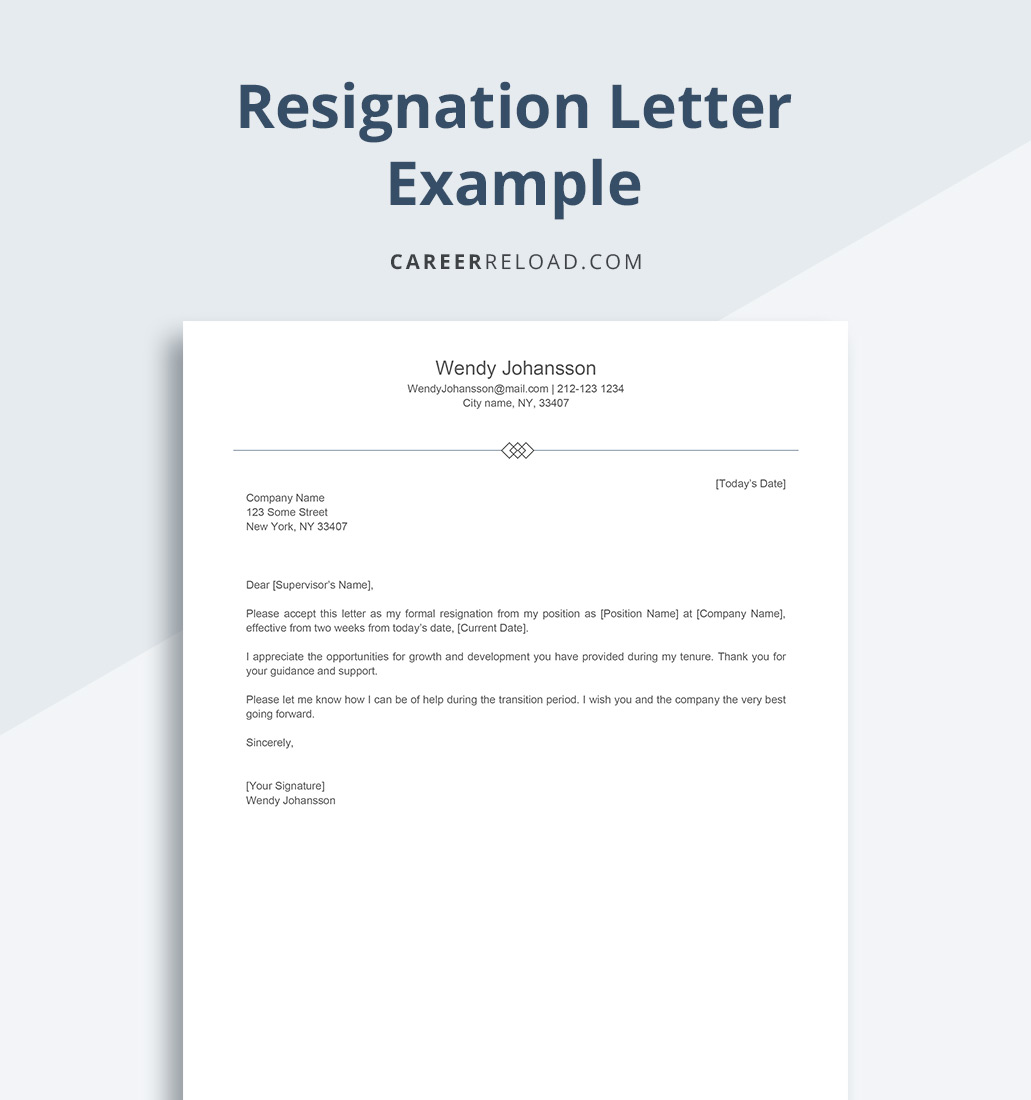
Resignation letter copy and paste
This is the copy-paste version of the above resignation letter template. You can paste it into your favorite text processor.
Email | Phone | City, State
Today’s Date
To:
Company Name
123 Some Street
New York, NY 33407
Dear [Supervisor’s Name],
Please accept this letter as my formal resignation from my position as [Position Name] at [Company Name], effective two weeks from today’s date, [Current Date].
I appreciate the opportunities for growth and development you have provided during my tenure. Thank you for your guidance and support.
Please let me know how I can be of help during the transition period. I wish you and the company the very best going forward.
Sincerely,
Your Name
Template 2
Resignation letter, Word version
Download the resignation letter and edit it with Microsoft Word or upload it to Google Docs.

Resignation letter copy and paste
Copy-paste version of the above resignation letter.
Email | Phone | City, State
Today’s Date
To:
Supervisor’s Name
Company Name
Address
City, State, ZIP
Dear [Supervisor’s Name],
I hope this letter finds you well. It is with a mixture of gratitude and excitement that I write to formally tender my resignation from my current position as [Position Name] at [Company Name]. My last day of work will be [Last Day], providing a notice period of two weeks as per the company policy.
I am sincerely grateful for the opportunities for professional growth and development that I have been provided during my time with [Company Name]. The support and encouragement from you and the entire team have been invaluable, and I will cherish the experiences I gained here.
As I prepare to start on a new chapter in my career, I am committed to ensuring a smooth handover of my responsibilities. I am more than willing to collaborate with my colleagues and assist in training my replacement or any other tasks necessary for a seamless transition.
Please feel free to reach out to me for any questions or guidance during this period. I want to express my heartfelt thanks to you and the entire team for making my time at [Company Name] truly remarkable.
I wish [Company Name] continued success and growth in the future. Thank you once again for everything.
Sincerely,
Your Name
You might also be interested in these examples:
What to include in a resignation letter
Five elements cover everything a good letter needs:
- A clear statement of resignation in the first line
- The specific last working day
- A short thank you
- An offer to help with the handover
- A professional sign-off with your full name and contact information
Anything else is optional. Length should sit between half a page and one page. If your draft is longer than that, you’re probably writing things that belong in a conversation, not a letter.
What to leave out of a resignation letter
The letter is a record, not a venting space. A few things consistently cause problems when people include them.
Detailed reasons for leaving belong in your exit interview or a private conversation with your manager, not in the file. Information about your new employer should also stay out. Even if you’re proud of where you’re going next, the letter to your current employer isn’t the venue.
Complaints about people, decisions, or culture have no place in the letter. Even if they’re true and even if you have receipts. A written complaint sitting in HR for years can come back when you least expect it, including when a future employer calls for a reference. Use the exit interview if you want to flag concerns, and use it sparingly.
Step-by-step instructions for covering your work shouldn’t be in the letter either. Offer help, then deliver the plan in a separate document or meeting once your manager confirms what they need.
How to deliver your resignation letter
In most U.S. workplaces, the standard sequence is a conversation first, then the letter. Tell your manager in person if you can, by phone call if you can’t. The letter follows within a few hours, by email to your manager with HR copied, with a printed and signed copy if HR or your contract asks for one.
A few specifics worth keeping in mind. Send the email to your direct manager and copy HR. Use a plain subject line, “Resignation, [Your Full Name],” works fine. Attach the letter as a PDF rather than pasting it into the email body, so the formatting holds up when it gets forwarded. Keep a copy for yourself.
Avoid resigning over Slack, Teams, or text. They feel casual, they’re hard to search later, and they leave a worse impression than the situation deserves.
When to submit your resignation letter
Give the standard two weeks unless your contract calls for more. Senior roles, regulated industries (finance, healthcare, legal), and roles with handover-heavy responsibilities often run three to four weeks. Some executive contracts ask for sixty or ninety days.
Time the conversation, and the letter that follows, for a day when your manager has space to react. Monday morning or early in a quiet week works better than Friday afternoon. Avoid resigning right before a major review, a board meeting, or the day before a holiday, unless circumstances genuinely give you no other window.
What happens after you submit
In most cases, your manager will acknowledge the letter, loop in HR, and start the handover conversation within a day or two. HR will send you exit paperwork covering final pay, accrued vacation, benefits continuation (COBRA), and the return of company property. You may be asked to participate in an exit interview, which can be skipped if you’d rather not give feedback.
Some employers ask departing employees to leave the same day, particularly in sales, finance, or roles with sensitive data. This is rare and not personal. If it happens, you’re still owed your notice period in pay under most contracts, and your final paycheck is governed by your state’s labor law.
Keep your handover focused on what you said you’d do in the letter. Maintaining that lasting impression of professionalism is the difference between a clean exit and a reference you’d rather not need.
Frequently asked questions
How long should a resignation letter be?
Half a page to one page is the right range. Three to five short paragraphs cover everything HR needs. Anything longer usually includes content that belongs in a conversation.
Do I have to give a reason for resigning?
No. A reason is optional in U.S. workplaces, and most professional letters leave it out. If you want to give one, keep it short and neutral, something like “to pursue a new opportunity” or “for personal reasons.”
Can I resign by email?
Yes, an email is acceptable in most U.S. workplaces, especially if you’ve already told your manager in person or by video call. Some industries and contracts require a printed, signed copy on file. Check your handbook.
Should I tell my manager before I send the letter?
Almost always, yes. A short in-person or video conversation before the letter lands shows respect and gives your manager the chance to react in private. The letter then serves as the written record of what you’ve already discussed.
What if my manager refuses to accept my resignation?
A resignation doesn’t need to be accepted to be valid. Send your letter, keep a copy, and copy HR on the email. Your last working day stands once written notice has been given.
Can I rescind a resignation letter after I’ve sent it?
Sometimes, if you act quickly and your employer agrees. There’s no legal obligation for the company to take you back once you’ve resigned, even if you change your mind the same day. If you’re considering rescinding, talk to your manager before HR formalizes the offboarding.
Final words
A resignation letter is a small document with a long shelf life. Keep it short, keep it professional, and lead with the news your reader needs. Follow the five-step structure, deliver it the right way, and you’ll close this chapter cleanly. If you’re still weighing the decision itself, our guide on how to quit a job is the right next read.

Sara has been in the career development field for over 10 years and has a wealth of knowledge to share. She covers topics such as resume writing, job search strategies, interview techniques, career planning, and more. She has curated our free downloadable resume templates for Word and resume templates for Google Docs.
Others also read
Reference Letter vs. Recommendation Letter
Peer Interviews: A Smart Way to Build Stronger Teams
18+ Best ATS-Friendly Resume Templates
Why College Career Fairs Are Still Valuable To Students
UX Designer Resume Examples to Land Your Dream Job
How to Write a Resume for Internal Position
Resume Summary vs Objective – What’s The Difference
Office Manager Resume Examples and Writing Guide
You Might Also Like These Free Templates
Resume Template in Word Document
Google Docs Resume Format – Debbie
Free Template for Resume
Free Resume Form Template
2 Column ATS Resume Template
ATS Friendly Resume Format for Word – Lindsay
Cover Letter Template with Monogram
Professional Cover Letter Template
Free Modern Resume Template for Word
Free Job Application Tracker for Excel
Free Resume Template Download for Word – Farrah
Free ATS-Friendly Resume Template – Emily