

A resume headline is a one-line statement at the top of your resume, right under your name, that names your professional identity in five to fifteen words. It pairs your job title with a specific skill, achievement, or qualifier so a hiring manager scanning for six seconds can tell whether you’re worth the next thirty. Think billboard, not paragraph.
A good headline does three jobs at once. It tells a human reader what you do, it feeds an applicant tracking system the exact job title it’s searching for, and it sets up everything below it on the page. Most candidates skip the headline entirely or fill it with empty words like “hardworking” and “team player.” That’s the gap you can use.
Also read:
- How to Write a Summary of Qualifications for a Resume
- How to Write a Resume Personal Statement
- Resume Summary vs Objective – What’s The Difference
Resume headline vs. resume summary vs. resume title
These three terms get used interchangeably and they shouldn’t. Each has a different job.
| Element | What it is | Length | Where it goes |
| Resume title | The name of the file or the job title you’re applying for | A few words | File name or top of the page |
| Resume headline | A one-line statement of your professional identity and value | 5 to 15 words | Under your name, above the summary |
| Resume summary | A paragraph that expands on the headline with context, skills, and results | 2 to 4 sentences, 40 to 60 words | Directly below the headline |
A headline declares. A summary explains. A title labels. If you can read your headline out loud and it sounds like a billboard, you got it right. If it sounds like the opening of a cover letter, it’s a summary in disguise.
Why a resume headline matters
Recruiters spend roughly seven seconds on the first pass of a resume before deciding to keep reading or move on. The headline sits at the top of the page, in the first place the eye lands, and it answers the only question that matters in those seconds. Is this person the right job title with the right skills for the role we’re hiring for?
There’s a second audience. Applicant tracking systems (ATS) parse the top of the resume first and weight matches near the top more heavily. When a recruiter searches the system for “Senior Marketing Manager” or “Registered Nurse with ICU experience,” your headline is what comes back. A headline written for a human reader doubles as the cleanest possible ATS signal.
The candidates who skip the headline lose both audiences at once. The page opens with a name, a phone number, and a wall of work history. Nobody knows what they do until paragraph two.
The resume headline formula
Most great headlines follow a simple pattern.
[Qualifier or descriptor] + [Job title] + [Differentiator]
The qualifier is a specific adjective or credential that signals seniority, certification, or specialization. The job title is the exact role you’re applying for. The differentiator is the thing that separates you from every other applicant with the same title, an achievement, a metric, a niche, a tool stack, a language combination, an industry.
Plain version: Marketing Manager
Formula version: B2B SaaS Marketing Manager Driving 40% Year-Over-Year Pipeline Growth
Plain version: Nurse
Formula version: Bilingual Registered Nurse With 8 Years of ICU Experience
Plain version: Software Engineer
Formula version: Backend Software Engineer Specializing in Distributed Systems and Go
The formula isn’t a rule, it’s scaffolding. Once you can write a headline that hits all three parts, you can break the pattern on purpose. What you can’t do is skip the differentiator and expect the headline to work.
How to write a resume headline in 6 steps
1. Start with the exact job title from the posting
Copy the job title from the listing word for word. If the posting says “Senior Product Designer,” your headline says “Senior Product Designer,” not “Product Design Lead” or “UX/UI Specialist.” Recruiters search the ATS by the title they wrote, and a different title means you don’t show up.
If you don’t have that title yet but you’re targeting it, use it as your aspirational title, as long as the rest of your resume backs it up. A candidate moving from senior engineer to engineering manager can lead with “Engineering Manager” if they’ve led teams in their last role, even without the formal title.
2. Add one specific differentiator
Pick the one thing on your resume that would make a hiring manager stop scanning. The order of preference goes like this. A quantified result beats a credential. A credential beats a tool. A tool beats an adjective.
Quantified result: Sales Manager Who Grew Territory Revenue From $4M to $11M in Three Years Credential: PMP-Certified Project Manager With 10 Years in Healthcare IT Tool stack: Data Engineer Fluent in Snowflake, dbt, and Airflow Adjective: Detail-Oriented Bookkeeper
The first version is the strongest. The fourth is the weakest. Most candidates write the fourth.
3. Cut every generic word
Words that signal nothing because every applicant uses them: hardworking, dedicated, motivated, passionate, team player, results-driven, dynamic, proven, strategic, innovative. None of those words separate you from anyone else.
If you need an adjective, pick one that points to a specific behavior. “Bilingual” tells a recruiter something. “Dedicated” tells them nothing.
4. Keep it to one line
A headline that wraps to a second line stops being a headline and starts being a summary. Most resume templates fit roughly 60 to 90 characters on one line in headline-size type. Count your characters before you commit.
If you have more to say, that’s what the summary below is for. The headline is the hook. The summary is the elaboration. Don’t combine them.
5. Use title case
A resume headline is a title, so capitalize it like one. Capitalize the first word, the last word, and every noun, verb, adjective, adverb, and pronoun in between. Lowercase the short words (a, an, the, and, but, or, for, of, on, in, at, to, with) unless they start the headline.
Wrong: senior software engineer with five years of backend experience Right: Senior Software Engineer With Five Years of Backend Experience
6. Rewrite it for every application
This is the step most candidates skip and the one that produces the most upside. A headline written for a generic “marketing role” will never match a specific posting as well as one written for the exact title and the exact requirements in the ad. Spend sixty seconds tailoring the headline before you submit. The hit rate jumps.
A simple rule. Open the job posting. Find the job title and the top two or three requirements in the “Required” section. Make sure your headline reflects the title and at least one of those requirements.
40 resume headline examples
These examples are organized by situation. Where the headline is doing something specific worth copying, I’ve noted why.
Experienced professionals
1. Senior Marketing Manager With 12 Years Building B2B SaaS Pipelines — Pairs the exact title with two specifics (years and industry). A recruiter searching “B2B SaaS marketing” matches immediately.
2. Top-Producing Account Executive Who Closed $4.2M in 202X
3. PMP-Certified Project Manager Specializing in Healthcare IT Implementations — Credential plus niche. Strong for any role where the niche is the gate.
4. Operations Director Who Cut Logistics Costs by 23% Across a 600-Employee Org
5. VP of Engineering With a Track Record Scaling Teams From 8 to 50+
6. Bilingual Sales Manager Closing Deals in English and Mandarin Across APAC
7. Tax Accountant Helping Small Businesses Stay IRS-Compliant for 15+ Years
8. Award-Winning Commercial Real Estate Broker With $250M in Career Transactions
Mid-career professionals
9. B2B Content Marketer Driving Organic Traffic Growth at SaaS Startups — No years, no awards, but the industry plus the function plus the outcome stack into a clear identity.
10. UX Designer With a Background in Cognitive Psychology
11. Full-Stack Developer Building Production Apps With React, Node, and PostgreSQL — Tool stack is doing the differentiation. Honest, specific, ATS-friendly.
12. HR Business Partner Trusted by Engineering Leaders at Two Series B Startups
13. Customer Success Manager Reducing Churn From 8% to 3% in Two Years
14. Civil Engineer Specializing in Bridge Inspection and Seismic Retrofitting
15. Paralegal With Seven Years in Mergers and Acquisitions Documentation
Recent graduates and entry-level
16. Computer Science Graduate With Internships at Google and Stripe — When you don’t have years of experience, brand-name internships are the differentiator. Use them.
17. Honors Marketing Graduate and Two-Time National Case Competition Finalist
18. Recent RN Graduate With 600+ Clinical Hours in Emergency Medicine
19. Mechanical Engineering Senior With Published Research in Additive Manufacturing
20. Communications Graduate Fluent in Spanish, French, and Portuguese
21. Aspiring Data Analyst With Coursera Certifications in SQL, Tableau, and Python — When the resume is thin on work experience, certifications and tools fill the differentiator slot. Don’t pretend to be senior. Be specific about what you can do.
Career changers
22. Former Teacher Transitioning to L&D With a TESOL Certification and Curriculum Design Portfolio — Names the change directly. Pretending the previous career didn’t happen is worse than owning it.
23. Ex-Investment Banker Pivoting Into Corporate Strategy at Mission-Driven Companies
24. Six-Year Army Logistics Officer Now Targeting Supply Chain Roles
25. Public Defender Moving Into Compliance and Regulatory Affairs
26. High School Math Teacher Pivoting to Data Science With a Recent MS in Statistics — The new credential earns the new title. The old career stays in the story.
Returners (re-entering the workforce)
27. Senior Product Manager Returning to Tech After a Three-Year Family Sabbatical — Naming the gap is stronger than hiding it. Recruiters notice gaps anyway. Owning it removes the question.
28. CPA Returning to Practice After Two Years of Caregiving, Currently Pursuing CPE Recertification
29. Former VP of Sales Re-Entering the Workforce After Cancer Recovery
Trades and skilled labor
30. OSHA-30 Certified Site Foreman With 14 Years on Commercial Construction Projects
31. Master Electrician Licensed in Three States With Solar Installation Experience
32. HVAC Technician With EPA Universal Certification and 8 Years in Residential Service
33. Welder With AWS D1.1 Certification Specializing in Structural Steel
Healthcare
34. Family Nurse Practitioner With 10 Years in Underserved Community Clinics
35. Pediatric Occupational Therapist Specializing in Sensory Processing Disorders
36. Registered Dietitian With a Sports Nutrition Certification and D1 Athletics Experience
Creative and design
37. Brand Designer Whose Identity Work Has Been Featured in Communication Arts and Brand New
38. Senior Copywriter With 50+ National TV Spots and Three Cannes Shortlists
39. Editorial Photographer Whose Work Has Appeared in The New York Times and National Geographic
Executive-level
40. CFO Who Led a Series C Round of $42M and IPO Readiness at a Climate-Tech Startup
Across the 40 examples, a pattern shows up. Specifics beat adjectives every time. Numbers beat claims. Named institutions and certifications beat vague seniority. The headlines that read as boring are usually doing too much. The ones that work are doing one thing clearly.
Common resume headline mistakes (with rewrites)
Mistake 1: Stuffing the line with buzzwords
Before: Results-Driven, Dynamic, Strategic Marketing Professional Passionate About Innovation
After: Senior Marketing Manager Who Doubled Inbound Leads at Two SaaS Startups
The first version uses five empty modifiers and one job title. The second uses one job title and one specific outcome. The second version is shorter and tells you ten times more.
Mistake 2: Writing it like a personal statement
Before: I am a hardworking and dedicated nurse who loves helping patients and is looking for a new opportunity in healthcare
After: Bilingual Registered Nurse With 6 Years in Pediatric Emergency Care
A headline is not a sentence about yourself. It’s a label for yourself. Drop the “I am.” Drop the verbs. State the identity.
Mistake 3: Using a title you don’t have
Before: Award-Winning, Internationally Recognized Designer
After: Senior Product Designer With Work Featured in Smashing Magazine and CSS-Tricks
If you haven’t actually won an award, don’t claim one. Hiring managers read the rest of the resume in thirty seconds and see the bluff. Use the specific recognition you do have, even if it’s smaller.
Mistake 4: Going too vague
Before: Experienced Professional Seeking Opportunities
After: Operations Manager With 9 Years Running Distribution Centers of 100+ Employees
“Experienced Professional” describes everyone over thirty with a job. Pick a title. Pick a number. Be findable.
Mistake 5: Burying the job title
Before: Hardworking Individual With Excellent Communication Skills and a Strong Work Ethic Looking for Customer Service Role
After: Customer Service Representative Comfortable Handling 80+ Calls Per Day
ATS searches by job title. If the job title is at the end of a fourteen-word string of fluff, the system parses it as low-priority. Lead with the title.
Mistake 6: Trying to fit your whole career into one line
Before: Former Teacher Turned Bootcamp Graduate Turned Junior Developer Now Pursuing Mid-Level Roles
After: Junior Full-Stack Developer With a Background in Curriculum Design
Three career stages don’t fit on one line. Pick the one that matters most for the role you’re targeting. The rest goes in the work history.
Where to place your resume headline
The headline sits in the resume header, directly under your name and above your contact line, or directly under your contact information. It should be visually distinct from the body of the resume. Most templates handle this by setting it in a slightly larger or bolder font than the section headings below, usually between 12 and 14 point if the body is 10 or 11.
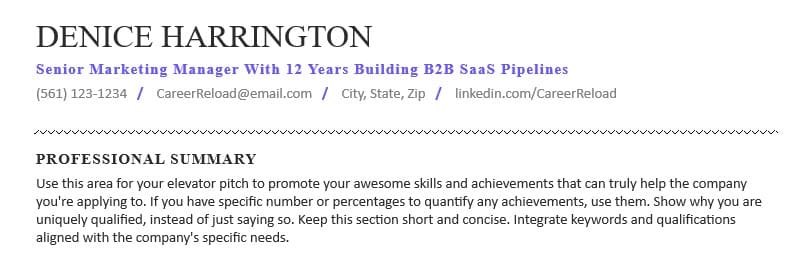
Don’t put it in a sidebar. Don’t put it in a colored block that the ATS might not parse. Keep it in the main content flow, in the same column as the rest of the resume, where the parser expects to find it.
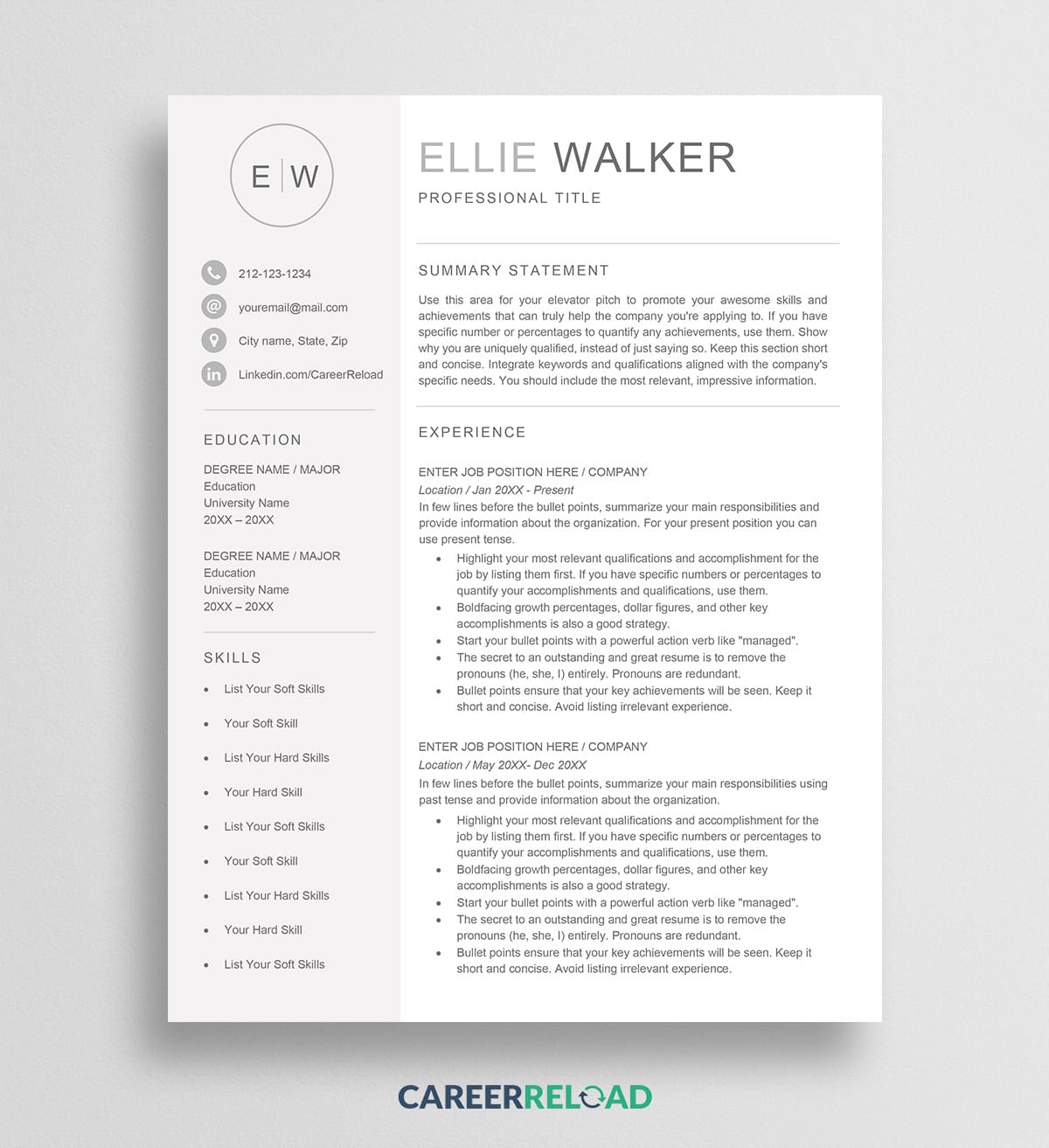
If you’re using a two-column resume template, put the headline in the main column, not the narrow sidebar.
Here are some ready-to-use resume templates where you can replace the “Professional Title” with your resume headline:


Resume headline vs. LinkedIn headline
The two look similar and serve different purposes.
A resume headline is optimized for two specific audiences. The ATS your application is going through, and the hiring manager who’ll scan your resume for the role you applied to. It should mirror the exact job title in the posting.
A LinkedIn headline is optimized for discovery. It’s the line that shows up next to your name in search results, in connection requests, and in InMail. It needs to work for every recruiter searching for someone like you, across every role you might consider, not just one job.
Practical result. Your LinkedIn headline can be broader and more identity-focused (Marketing Leader Helping B2B SaaS Companies Build Pipeline). Your resume headline should be narrower and more application-focused (Senior Demand Generation Manager With 8 Years in B2B SaaS). Don’t copy and paste between the two.
Frequently asked questions
How long should a resume headline be?
Five to fifteen words, fitting on one line in your resume’s headline font size. Once it wraps to a second line, it stops being a headline and starts being a summary. Aim for 60 to 90 characters total.
Do I need both a resume headline and a resume summary?
You don’t strictly need both, but they work together. The headline gives the hiring manager the five-second answer. The summary gives them the thirty-second one. If you only have room for one, write the headline and skip the summary rather than the reverse.
Should I write a new resume headline for every job?
Yes, ideally. The single most valuable minute you can spend on your resume is rewriting the headline to match the job title and one core requirement in the posting. The rest of the resume stays the same. The headline gets tailored.
Can I use a resume headline without years of experience?
Yes. When you don’t have years to point to, use what you do have. A degree (in progress or completed), a certification, a tool stack, a relevant internship, a language, a volunteer credential, a portfolio piece. Recent graduates and career changers often write stronger headlines than mid-career candidates because they have to be specific to compete.
Should I include keywords from the job description in my headline?
Yes, but with a limit. The job title from the posting is the most important keyword and should appear in your headline. One or two more (a key skill, a certification, an industry) is fine. Beyond that, the headline becomes a keyword string and stops working for the human reader.
Is “Seeking a position in X” a good headline?
No. A headline states what you are, not what you want. “Marketing Manager With 8 Years in B2B SaaS” is stronger than “Marketing Professional Seeking a B2B SaaS Role.” The first sounds like a peer. The second sounds like an applicant.
Bottom line
A resume headline is the cheapest, highest-leverage edit you can make to your resume. Sixty seconds of work, written for the specific role you’re applying to, using the formula of qualifier plus exact job title plus one specific differentiator. Cut the buzzwords. Lead with the title the recruiter is searching for. Back it up with a number, a credential, or a niche the rest of your resume proves.
If you’re not sure yours is working, read it out loud. If it sounds like a billboard, you’re done. If it sounds like the start of a cover letter, rewrite it.

Sara has been in the career development field for over 10 years and has a wealth of knowledge to share. She covers topics such as resume writing, job search strategies, interview techniques, career planning, and more. She has curated our free downloadable resume templates for Word and resume templates for Google Docs.
Others also read
How to Write a Scholarship Resume (Examples & Templates)
How to Write an Impressive Medical Resume
How to Build a Personal Brand That Attracts Job Offers
Cybersecurity Resume Examples, Template & Writing Guide
Physical Therapist Resume Examples to Build an Impressive Resume
18+ Best ATS-Friendly Resume Templates
How to Create a SOAR Method Resume
6 Free Resume Review Services
You Might Also Like These Free Templates
Resume Template in Word Document
Google Docs Resume Format – Debbie
Free Template for Resume
Free Resume Form Template
2 Column ATS Resume Template
ATS Friendly Resume Format for Word – Lindsay
Cover Letter Template with Monogram
Professional Cover Letter Template
Free Modern Resume Template for Word
Free Job Application Tracker for Excel
Free Resume Template Download for Word – Farrah
Free ATS-Friendly Resume Template – Emily