

In the current job market, your resume is often just one of hundreds sitting in a digital queue. While technical certifications and hands on experience are essential, they are frequently not enough to distinguish you from other qualified candidates. This is where a well crafted cybersecurity cover letter comes into play. Think of this document as the human firewall of your job application. It is your first opportunity to demonstrate your communication skills, your strategic thinking, and your ability to mitigate risks before you even step into an interview room.
Many applicants make the mistake of treating their cover letter as a simple summary of their resume. However, a cybersecurity cover letter should serve a much higher purpose. It should provide context to your technical achievements and show a hiring manager how you think about security in a business context. In a field where a single mistake can lead to a catastrophic data breach, your ability to present yourself clearly and professionally is a direct reflection of your attention to detail.
Cybersecurity cover letter example

Cybersecurity cover letter sample (copy-paste)
View more cover letters by industry.
Dear Name (or hiring manager),
I am writing to express my strong interest in the Cybersecurity Analyst position at Nexus Defense Systems. Having followed your recent expansion into automated threat intelligence, I am eager to bring my two years of SOC experience to your team. This cybersecurity cover letter outlines how my background in incident response and alert optimization aligns with your current security goals.
In my current role at Guardian MSSP, I noticed that our team was losing valuable time to alert fatigue. I took the initiative to audit our SIEM correlation rules, which resulted in a 25 percent reduction in false positives and a 15 percent improvement in our mean time to resolve (MTTR) critical incidents. This experience taught me that an effective cybersecurity cover letter must demonstrate not just technical knowledge, but a commitment to operational efficiency.
Beyond technical monitoring, I have developed a strong foundation in vulnerability management and endpoint protection. During a recent spear phishing attempt, I successfully isolated infected hosts and prevented data exfiltration, later translating the technical findings into a security awareness briefing for the executive board. My ability to communicate risk to non technical stakeholders is a key part of my information security cover letter.
With my CompTIA Security+ certification and proficiency in tools like Splunk and CrowdStrike, I am ready to help Nexus Defense Systems maintain its high standards of data integrity. I look forward to discussing how my proactive approach to threat hunting can support your security operations. Thank you for considering my cyber security application letter.
Sincerely,
Your name
Why your cybersecurity cover letter is the human firewall of your application
The concept of a human firewall refers to the layer of security provided by people who are trained to spot and stop threats. In the context of a job search, your cybersecurity cover letter acts as a filter that allows the right information to reach the hiring manager while blocking out the noise of generic applications. Automated Applicant Tracking Systems (ATS) are designed to scan for specific keywords, but human recruiters are looking for something more: they are looking for culture fit, passion, and proof of critical thinking.
A cybersecurity resume shows what you have done, but the cover letter explains how you did it and why it mattered. For instance, while a resume might list that you managed a firewall, your cybersecurity cover letter can explain how you optimized that firewall to reduce latency while simultaneously blocking a 20 percent increase in malicious traffic. This narrative approach transforms you from a list of technical specifications into a living, breathing professional who can solve real world problems.
The pre-exploit phase: Researching the company’s security posture
In the world of ethical hacking, the reconnaissance phase is the most critical part of any engagement. The same principle applies when writing a cybersecurity cover letter. Before you type a single word, you must perform deep research into the organization you are targeting. This is not just about knowing what the company sells, but about understanding their specific security needs and challenges.
Start by identifying the target. Finding the actual name of the hiring manager or the Chief Information Security Officer (CISO) is a high value activity. Use LinkedIn or the company’s about us page to find the specific person leading the security team. Addressing your letter to a specific individual immediately sets you apart from the dozens of candidates who use generic greetings like To Whom It May Concern.
Next, analyze the job description for pain points. Companies do not hire security professionals for no reason. They hire because they have a problem to solve. Are they migrating their legacy systems to the cloud? Are they expanding their internal Security Operations Center (SOC)? Are they struggling with compliance in a newly regulated market? Your cybersecurity cover letter should address these specific needs directly. By mirroring their language and showing you understand their technical debt or growth goals, you prove that you are an insider who knows the industry.
Finally, consider the technical stack. If the job description mentions specific tools like Splunk, CrowdStrike, or Palo Alto Networks, make sure your information security cover letter reflects your familiarity with these ecosystems. This is not just about listing tools, it is about demonstrating how you use them to create a more secure environment.
The header and professional salutation: Setting a secure foundation
The header of your cybersecurity cover letter should be clean, professional, and provide multiple ways for the recruiter to verify your identity and skills. In addition to your phone number and email address, you should include links to professional platforms. A link to your LinkedIn profile is standard, but for technical roles, a link to a GitHub repository, a personal blog, or even a TryHackMe profile can be incredibly effective. These links provide immediate proof of your active engagement with the cybersecurity community.
When it comes to the salutation, accuracy is paramount. In a field defined by precision, getting a name wrong or using an outdated title is a major red flag. If you absolutely cannot find a specific name after exhaustive research, use a targeted title such as Dear Cybersecurity Hiring Team or Dear CISO Search Committee. This shows that you have at least directed your letter to the correct department, which is far better than a vague opening.
The opening hook: Capturing attention in the first packet transfer
In networking, the initial handshake determines if a connection will be established. Your opening paragraph serves a similar function. You must capture the reader’s attention immediately by showing them that you are not just another applicant, but a solution to their problems. There are three primary ways to approach this:
The first is the problem solver approach. You can start by mentioning a specific challenge the industry is facing, such as the rise in ransomware or supply chain vulnerabilities, and then state how your skills specifically address that threat. For example, you might mention how your experience in threat hunting allows you to identify lateral movement before a breach occurs.
The second is the passion approach. This involves mentioning a specific initiative the company has recently undertaken. If the company recently published a white paper on zero trust architecture or won an award for data privacy, mention it. This shows that you are genuinely interested in their specific mission, which is a key component of a successful cybersecurity cover letter.
The third is the referral approach. If you were recommended for the position by a current employee, state this in the very first sentence. Referrals are highly valued in the security industry because trust is the most important currency. Leveraging a known connection can often bypass many of the initial hurdles in the hiring process.
The technical core: Demonstrating your defense in depth
The middle section of your cybersecurity cover letter is where you prove your technical mettle. Rather than listing every skill you possess, choose two or three key requirements from the job description and expand on them using the Situation, Action, Result (SAR) method. This framework is highly effective because it provides measurable proof of your impact.
For example, instead of saying you are good at incident response, you could write: During a recent phishing outbreak at my previous firm, I led the incident response team in isolating affected endpoints within thirty minutes of the initial alert. By implementing new automated mail filters, I reduced future phishing successful deliveries by 45 percent. This kind of data driven narrative is what hiring managers look for in a top tier cyber security application letter.
You should also use this section to weave in your certifications naturally. Rather than saying I have a CISSP, you might say: Utilizing the strategic frameworks learned during my CISSP certification, I revamped our internal risk assessment process to align with NIST standards. This demonstrates that you don’t just have the certificate, you have the ability to apply that knowledge to real world business operations.
Top cover letter templates for cybersecurity
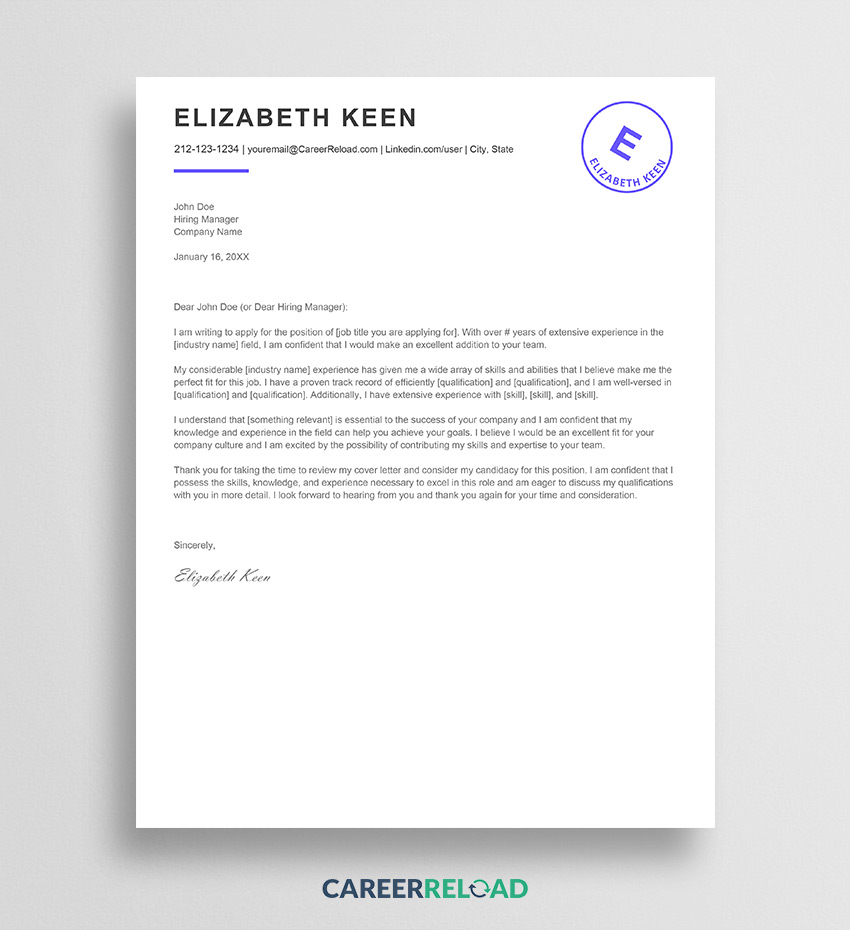

Professional cover letter template

Cover letter template download
The soft skill layer: Why the best security professionals are great communicators
One of the biggest misconceptions in the industry is that cybersecurity is only about technical expertise. In reality, some of the most critical work involves people and processes. Your cybersecurity cover letter must highlight your soft skills, particularly your ability to communicate complex technical risks to non technical stakeholders.
Hiring managers want to know if you can explain a critical vulnerability to a Board of Directors without causing unnecessary panic or getting bogged down in jargon. They want to see that you have empathy for the end users who have to follow security protocols. Mentioning your experience in conducting security awareness training or collaborating with developers to implement secure coding practices can significantly strengthen your application.
Furthermore, ethics and integrity are the backbone of the profession. Use your information security cover letter to briefly touch upon your commitment to ethical standards. Whether it is your adherence to a specific code of ethics or your experience in maintaining compliance with regulations like GDPR, HIPAA, or SOC2, showing that you are a reliable and principled professional is essential for building trust.
Tailoring for the specific role: One size does not fit all
A generic cybersecurity cover letter is easy to spot and even easier to ignore. To be truly effective, your letter must be tailored to the specific subfield of the role you are applying for.
- For a SOC Analyst role: Focus on your vigilance, your ability to work under pressure during high severity alerts, and your proficiency with monitoring tools like SIEMs and EDRs. Mention your experience with log analysis and your speed in triage.
- For a Penetration Tester role: Highlight your creative problem solving skills and your ability to think like an adversary. Focus on your methodology for discovering vulnerabilities and, more importantly, your ability to provide actionable remediation advice.
- For a GRC (Governance, Risk, and Compliance) Specialist: Emphasize your knowledge of frameworks such as ISO 27001 or COBIT. Focus on your documentation skills and your ability to conduct thorough internal audits that ensure the company remains on the right side of the law.
- For a Cybersecurity Manager: Your letter should focus on leadership, budgeting, and strategic alignment. Talk about how you have managed teams, how you have justified security spend to the CFO, and how you have aligned security goals with the overall business strategy.
Navigating the AI era: Using and not abusing LLMs
It is a given that many candidates will use Artificial Intelligence to help draft their application materials. While AI can be a powerful tool for brainstorming and structuring your cybersecurity cover letter, relying on it too heavily can backfire. Hiring managers are becoming increasingly adept at spotting the generic, overly polished, and often repetitive tone of unedited AI text.
If you use AI, treat it as a research assistant or a first draft generator. Use it to help you find powerful action verbs or to check your grammar. However, the core stories, the specific technical results, and the personal voice must be yours. A cybersecurity cover letter that feels like it was written by a robot suggests to a hiring manager that you might be the type of employee who takes shortcuts in your technical work as well.
The verification step is also crucial. AI models can sometimes hallucinate or exaggerate skills. Always double check that your letter does not inadvertently claim a certification you are still working on or a tool you have only used once. In security, your word is your bond, and any inaccuracy in your cover letter can be seen as a breach of trust.
The closing statement: Initiating a handshake protocol
Your closing paragraph should be brief, confident, and forward looking. This is your final chance to leave a positive impression. Start by reiterating your enthusiasm for the role and summarizing in one sentence why your unique combination of skills makes you the ideal candidate for their specific environment.
Crucially, you must include a clear call to action. Instead of saying I hope to hear from you, use a more proactive approach. You might say: I look forward to the opportunity to discuss how my experience in cloud security can help protect your upcoming infrastructure migration. This sets the stage for a conversation rather than a passive wait.
Finish with a professional sign off such as Sincerely or Respectfully, followed by your name. This formal conclusion maintains the professional tone you have established throughout the document.
The final audit: A checklist for your cybersecurity cover letter
Before you hit send on your cybersecurity application letter, you must perform a final audit. In a field where a single misplaced character in a script can crash a server, your cover letter must be flawless.
- Check the formatting: Is the font professional and easy to read? Are the margins consistent? Always send your document as a PDF, rather than a Word cover letter, to ensure that the formatting remains intact regardless of the device the recruiter uses to open it.
- The brevity test: Is your letter under one page? Ideally, it should be between 300 and 400 words. Recruiters often spend less than thirty seconds reading a cover letter, so every word must earn its place on the page.
- The error scan: Read your letter out loud. This is the best way to catch awkward phrasing or missing words that your eyes might skip over when reading silently. Use a spell checker, but do not rely on it exclusively. Check for technical terms specifically, as standard spell checkers often struggle with specialized cybersecurity terminology.
- The link check: If you included links to your portfolio or LinkedIn, click them one last time to ensure they are not broken and lead to the correct destination.
Conclusion: Launching your career in the SOC
Writing an effective cybersecurity cover letter is an investment in your career. It is the bridge between your technical qualifications and the human decision makers who hold the keys to your next opportunity. By taking the time to research the company, highlight your technical impact through the SAR method, and demonstrate your soft skills, you position yourself as a high value, low risk hire.
Remember that the goal of the cybersecurity cover letter is not just to get a job, but to start a professional relationship based on competence and trust. As the threat landscape continues to evolve, companies are looking for professionals who are not only technically proficient but also proactive, communicative, and deeply invested in the mission of security. Use this guide to build a letter that proves you are exactly the professional they need to strengthen their defenses. With a clear strategy and a focus on quality over quantity, your application will stand out as a beacon of professionalism in a crowded field.

Alex is a career expert who specializes in resume writing and job search strategies. He focuses on sharing real-world tips that make work and job search feel more manageable.
Others also read
How to Prepare and Succeed in a Group Job Interviews
9 Tips for Getting Your Resume Past The Applicant Tracking System (ATS)
How to Write an Executive Resume
How to Write an Impressive Medical Resume
Canva Resume Builder Review
How Personality Tests Can Help You in Your Career and Job Search
10 Healthcare Resume Templates and Examples for 2026
Substitute Teacher Resume Example & Writing Guide
You Might Also Like These Free Templates
Resume Template in Word Document
Google Docs Resume Format – Debbie
Free Template for Resume
Free Resume Form Template
2 Column ATS Resume Template
ATS Friendly Resume Format for Word – Lindsay
Cover Letter Template with Monogram
Professional Cover Letter Template
Free Modern Resume Template for Word
Free Job Application Tracker for Excel
Free Resume Template Download for Word – Farrah
Free ATS-Friendly Resume Template – Emily