

A full-stack developer, a front-end developer, and a back-end developer can share the exact same resume structure and still need three different resumes. The sections stay the same. What changes is which skills lead, which projects you feature, and which numbers go in your bullet points. A front-end developer resume leads with interface work and JavaScript frameworks. A back-end developer resume leads with APIs, databases, and reliability. A full-stack developer resume shows both and proves you can connect them.
That difference is the whole game. Get the shared structure right, then tune the top third of the page to the role you actually want.
Software work keeps expanding, which raises the bar rather than lowering it. The Bureau of Labor Statistics projects software developer employment to grow 15 percent over the decade, far faster than the average for all occupations. More openings pull in more applicants, and strong candidates land on the same shortlist. Your resume is the filter that decides whether you make it there.
Jump to the examples:
Also read:
The resume sections every developer needs
Before the roles split apart, they share a spine. Every developer resume, regardless of stack, runs on the same six sections in reverse-chronological order.
Start with a header that carries your name, city and state, phone, email, and three links that do real work: a portfolio, your GitHub, and your LinkedIn. Hiring managers click these before they finish reading. A dead or missing link costs you interviews you never hear about.
Under the header goes a two or three line summary that names the role, your years of experience, and one signature strength. Skip the objective statement. Nobody needs to be told you are seeking a challenging position.
Then comes a technical skills section, professional experience with quantified bullets, a projects section, and education with certifications at the bottom. Keep the whole thing to one page if you have under ten years of experience. Two pages is fine for senior and staff candidates with a track record to match.
For the graduation year, there are a few reasons it’s often omitted:
- It helps reduce the potential for age-related bias during hiring.
- After about 3 to 5 years of professional experience, employers typically care much more about work history than graduation date.
- Many career coaches recommend listing only the degree, school, and optionally honors or GPA (if recent).
That said, including the graduation year is perfectly acceptable, especially if:
- the candidate graduated recently,
- the year helps establish the timeline, or
- it’s customary in the country where they’re applying.
How front-end, back-end, and full-stack resumes differ
The three roles touch different parts of the same application, so the same accomplishment gets described in different terms. A front-end developer talks about what the user sees and how fast it loads. A back-end developer talks about what happens after the request leaves the browser. A full-stack developer talks about owning a feature from the button click to the database write.
Here is how the three resumes diverge at the top of the page.
| Role | Resume leads with | Core stack to show | Metrics that prove impact |
| Front-end developer | Interface work, JavaScript frameworks, accessibility | HTML, CSS, JavaScript, TypeScript, React or Vue or Angular | Load time, Core Web Vitals, conversion lift, bundle size, accessibility compliance |
| Back-end developer | APIs, databases, system reliability | Python or Node or Java, SQL and NoSQL, cloud, containers | API latency, throughput, uptime, query time, infrastructure cost |
| Full-stack developer | End-to-end feature ownership across both layers | A front-end framework plus a back-end language, a database, a deploy pipeline | Features shipped end to end, time to market, plus one front and one back metric |
Read the table top to bottom and the pattern is clear. Front-end proves speed and polish. Back-end proves scale and stability. Full-stack proves range and delivery.
How to write a front-end developer resume
A front-end developer resume has to show three things fast: you write clean, modern JavaScript, you build interfaces people can actually use, and your work makes a measurable difference to the product.
Lead your summary with the framework you know best and one number that shows outcome, not activity. “Front-end developer with five years in React who cut checkout load time by 60 percent” beats “passionate developer with strong attention to detail” every time.
In your experience bullets, name the framework, name the problem, and name the result. Accessibility belongs here too. Teams increasingly treat WCAG compliance as a requirement rather than a bonus, so a bullet about clearing an accessibility audit signals maturity. Performance work is your strongest card. Page speed, Core Web Vitals, bundle size, and conversion are the numbers front-end hiring managers trust.
Your projects section should link to live work, not just repos. A recruiter who can click through to a running app you built learns more in ten seconds than a page of bullets can tell them.
Front-end developer resume example
This front-end developer resume example can also be adapted for React-focused, Angular-focused, Vue-focused, or senior frontend positions by changing the technical skills, projects, and work experience.
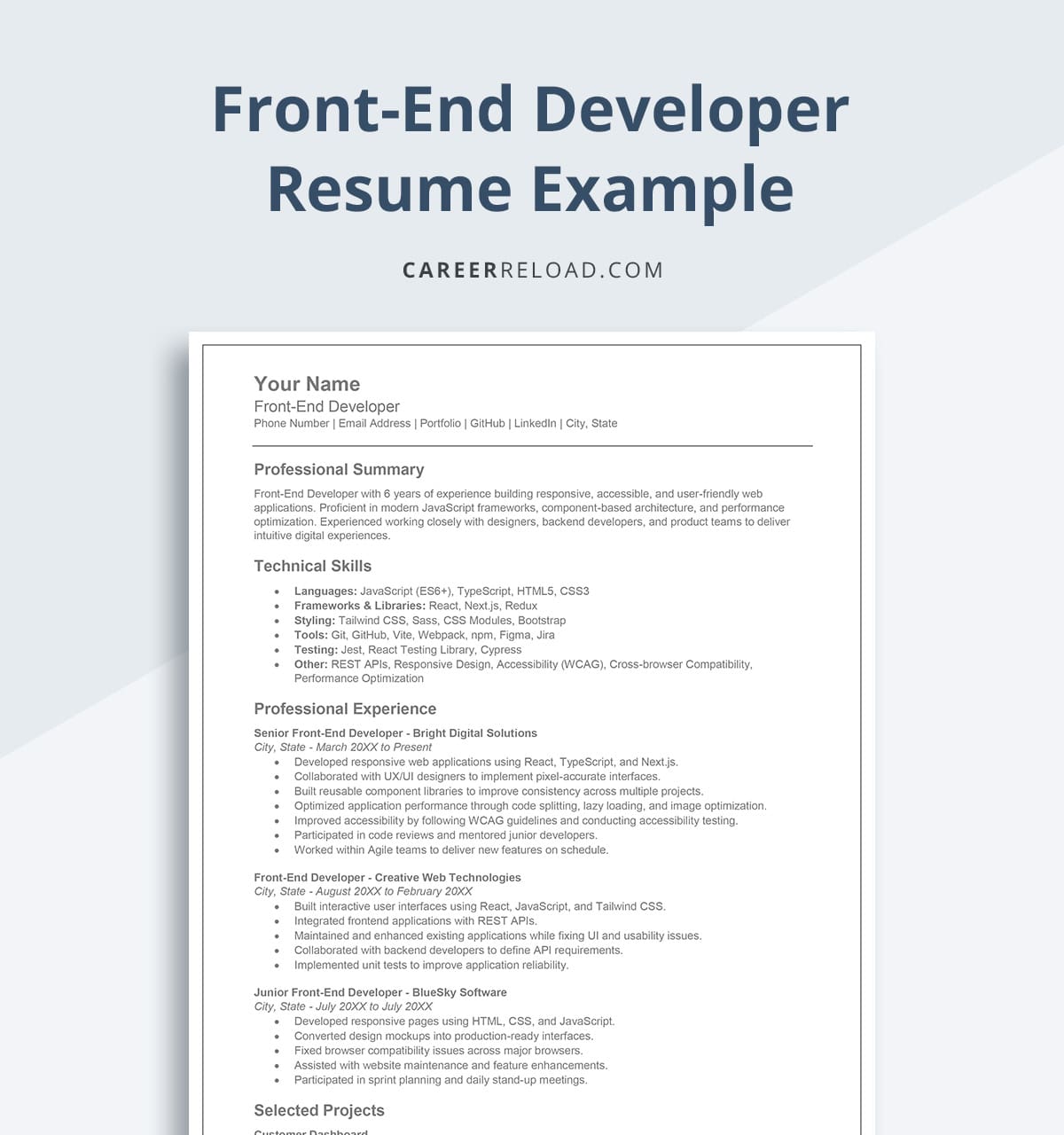
Front-end developer resume example (copy-paste)
Your Name
Front-End Developer
Phone Number | Email Address | City, State | Portfolio | GitHub | LinkedIn
Professional Summary
Front-End Developer with 6 years of experience building responsive, accessible, and user-friendly web applications. Proficient in modern JavaScript frameworks, component-based architecture, and performance optimization. Experienced working closely with designers, backend developers, and product teams to deliver intuitive digital experiences.
Technical Skills
- Languages: JavaScript (ES6+), TypeScript, HTML5, CSS3
- Frameworks & Libraries: React, Next.js, Redux
- Styling: Tailwind CSS, Sass, CSS Modules, Bootstrap
- Tools: Git, GitHub, Vite, Webpack, npm, Figma, Jira
- Testing: Jest, React Testing Library, Cypress
- Other: REST APIs, Responsive Design, Accessibility (WCAG), Cross-browser Compatibility, Performance Optimization
Professional Experience
Senior Front-End Developer – Bright Digital Solutions
City, State – March 20XX to Present
- Developed responsive web applications using React, TypeScript, and Next.js.
- Collaborated with UX/UI designers to implement pixel-accurate interfaces.
- Built reusable component libraries to improve consistency across multiple projects.
- Optimized application performance through code splitting, lazy loading, and image optimization.
- Improved accessibility by following WCAG guidelines and conducting accessibility testing.
- Participated in code reviews and mentored junior developers.
- Worked within Agile teams to deliver new features on schedule.
Front-End Developer – Creative Web Technologies
City, State – August 20XX to February 20XX
- Built interactive user interfaces using React, JavaScript, and Tailwind CSS.
- Integrated frontend applications with REST APIs.
- Maintained and enhanced existing applications while fixing UI and usability issues.
- Collaborated with backend developers to define API requirements.
- Implemented unit tests to improve application reliability.
Junior Front-End Developer – BlueSky Software
City, State – July 20XX to July 20XX
- Developed responsive pages using HTML, CSS, and JavaScript.
- Converted design mockups into production-ready interfaces.
- Fixed browser compatibility issues across major browsers.
- Assisted with website maintenance and feature enhancements.
- Participated in sprint planning and daily stand-up meetings.
Selected Projects
Customer Dashboard
- Built a responsive analytics dashboard using React, TypeScript, and Chart.js.
- Implemented reusable UI components and state management with Redux.
- Improved page load performance through lazy loading and code optimization.
Company Design System
- Developed a reusable component library for buttons, forms, modals, tables, and navigation.
- Worked closely with designers to ensure consistent branding and user experience.
- Documented components to support adoption across development teams.
Education
Bachelor of Science in Information Technology
State University
Certifications
- Meta Front-End Developer Certificate
- Google UX Design Certificate
Additional Information
- Strong understanding of responsive and mobile-first design principles.
- Experienced in collaborating with cross-functional teams.
- Passionate about creating accessible, high-quality user experiences.
- Committed to continuous learning and staying current with modern frontend technologies.
How to write a back-end developer resume
A back-end developer resume answers a different question: can you build systems that stay up, stay fast, and stay affordable as traffic grows?
Lead with the languages and databases you know deepest, then prove them in your experience. The verbs matter here. “Designed,” “architected,” “scaled,” and “optimized” carry more weight than “worked on” because they claim ownership of decisions.
Your bullets live and die on system metrics. Requests per second, p95 and p99 latency, uptime percentage, query time, and infrastructure cost tell a hiring manager you understand production, not just code. A bullet like “cut average query time 70 percent with composite indexes and a Redis cache” does more than a paragraph of adjectives.
Show the shape of what you have built. Mention whether you worked in a monolith or microservices, which cloud you deployed to, and how you handled auth, caching, and messaging. Back-end interviews probe system design early, so a resume that hints at architecture thinking gets you a better first conversation.
Back-end developer resume example
This back-end developer resume example can be tailored for Java, Python, .NET, Node.js, Go, or PHP backend roles by updating the technical skills, frameworks, and project experience.
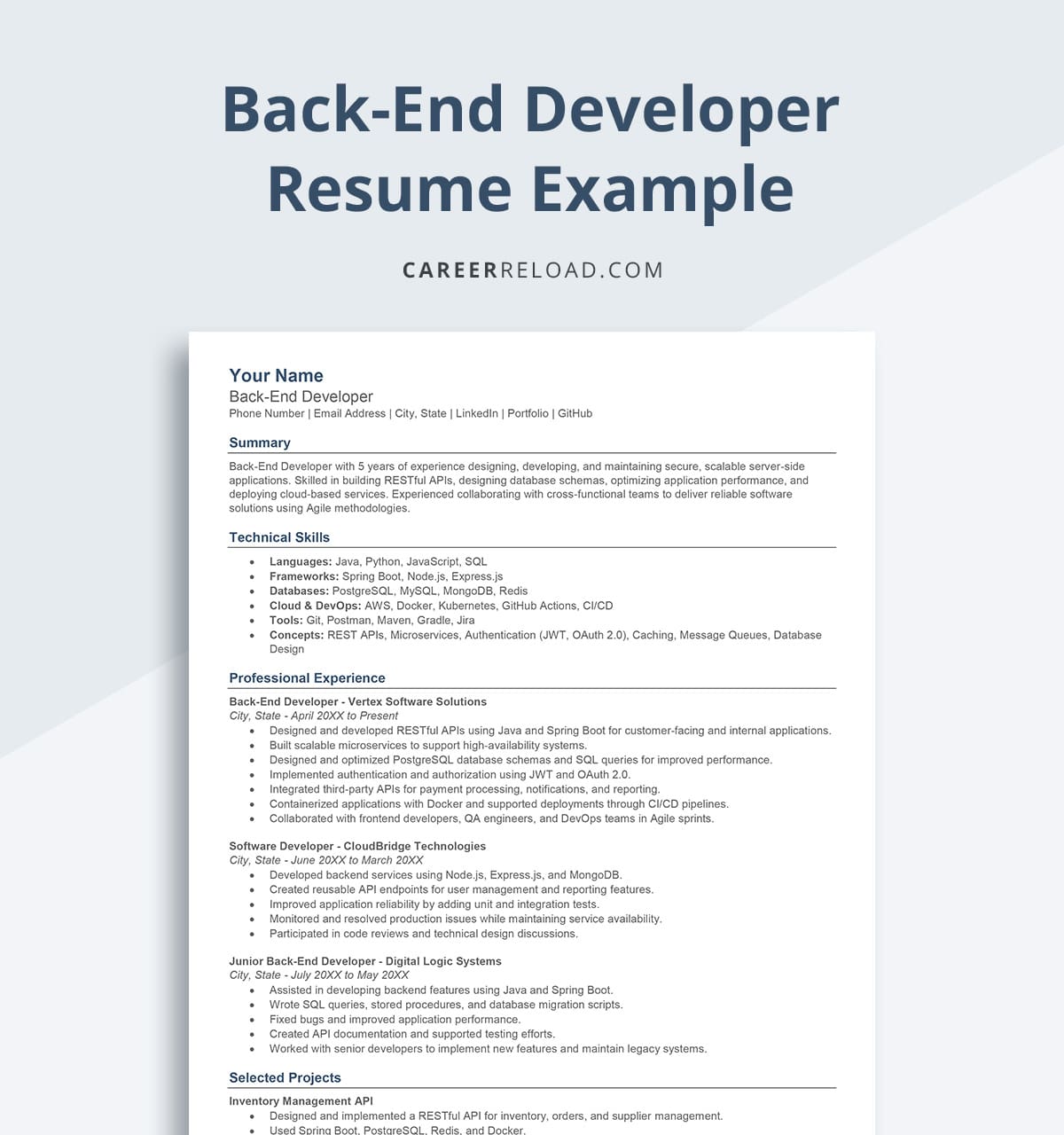
Back-end developer resume example (copy-paste)
Your Name
Back-End Developer
Phone Number | Email Address | City, State | Portfolio | GitHub | LinkedIn
Professional Summary
Back-End Developer with 5 years of experience designing, developing, and maintaining secure, scalable server-side applications. Skilled in building RESTful APIs, designing database schemas, optimizing application performance, and deploying cloud-based services. Experienced collaborating with cross-functional teams to deliver reliable software solutions using Agile methodologies.
Technical Skills
- Languages: Java, Python, JavaScript, SQL
- Frameworks: Spring Boot, Node.js, Express.js
- Databases: PostgreSQL, MySQL, MongoDB, Redis
- Cloud & DevOps: AWS, Docker, Kubernetes, GitHub Actions, CI/CD
- Tools: Git, Postman, Maven, Gradle, Jira
- Concepts: REST APIs, Microservices, Authentication (JWT, OAuth 2.0), Caching, Message Queues, Database Design
Professional Experience
Back-End Developer – Vertex Software Solutions
City, State – April 20XX to Present
- Designed and developed RESTful APIs using Java and Spring Boot for customer-facing and internal applications.
- Built scalable microservices to support high-availability systems.
- Designed and optimized PostgreSQL database schemas and SQL queries for improved performance.
- Implemented authentication and authorization using JWT and OAuth 2.0.
- Integrated third-party APIs for payment processing, notifications, and reporting.
- Containerized applications with Docker and supported deployments through CI/CD pipelines.
- Collaborated with frontend developers, QA engineers, and DevOps teams in Agile sprints.
Software Developer – CloudBridge Technologies
City, State – June 20XX to March 20XX
- Developed backend services using Node.js, Express.js, and MongoDB.
- Created reusable API endpoints for user management and reporting features.
- Improved application reliability by adding unit and integration tests.
- Monitored and resolved production issues while maintaining service availability.
- Participated in code reviews and technical design discussions.
Junior Back-End Developer – Digital Logic Systems
City, State – July 20XX to May 20XX
- Assisted in developing backend features using Java and Spring Boot.
- Wrote SQL queries, stored procedures, and database migration scripts.
- Fixed bugs and improved application performance.
- Created API documentation and supported testing efforts.
- Worked with senior developers to implement new features and maintain legacy systems.
Selected Projects
Inventory Management API
- Designed and implemented a RESTful API for inventory, orders, and supplier management.
- Used Spring Boot, PostgreSQL, Redis, and Docker.
- Added role-based access control, request validation, and centralized error handling.
Notification Service
- Developed a microservice to send email and SMS notifications.
- Integrated external messaging providers and implemented retry logic for failed deliveries.
- Improved service scalability through asynchronous message processing.
Education
Bachelor of Science in Computer Science
Texas State University
Certifications
- AWS Certified Developer – Associate
- Oracle Certified Professional, Java SE Developer
Additional Information
- Strong understanding of software design principles and object-oriented programming.
- Experience with API design, database optimization, and cloud-native application development.
- Effective collaborator with strong analytical and problem-solving skills.
- Committed to writing clean, maintainable, and well-tested code.
How to write a full-stack developer resume
A full-stack developer resume has the hardest balancing act. You have to prove range without looking shallow. The trap is listing 30 technologies across both layers and demonstrating depth in none.
The fix is to lead with end-to-end ownership. Frame at least one accomplishment as a full feature you carried from interface to database. “Shipped a billing feature end to end in React, Node, and PostgreSQL” tells a hiring manager exactly what full-stack means to you.
Pick a primary stack and make it obvious. Most full-stack roles want one coherent combination, such as React with Node and PostgreSQL, or Next.js with a Python back end. A resume that names a clear stack reads as more credible than one that scatters every tool you have seen.
Pair your metrics. Show one front-end number and one back-end number in the same resume so both sides land. A page load cut on the dashboard and an API latency cut on the service together prove you actually work across the stack rather than favoring one half.
Full-stack developer resume example
This full-stack developer resume example can be tailored toward frontend-heavy, backend-heavy, startup, enterprise, or remote-focused roles by adjusting the summary, skills, and project experience.
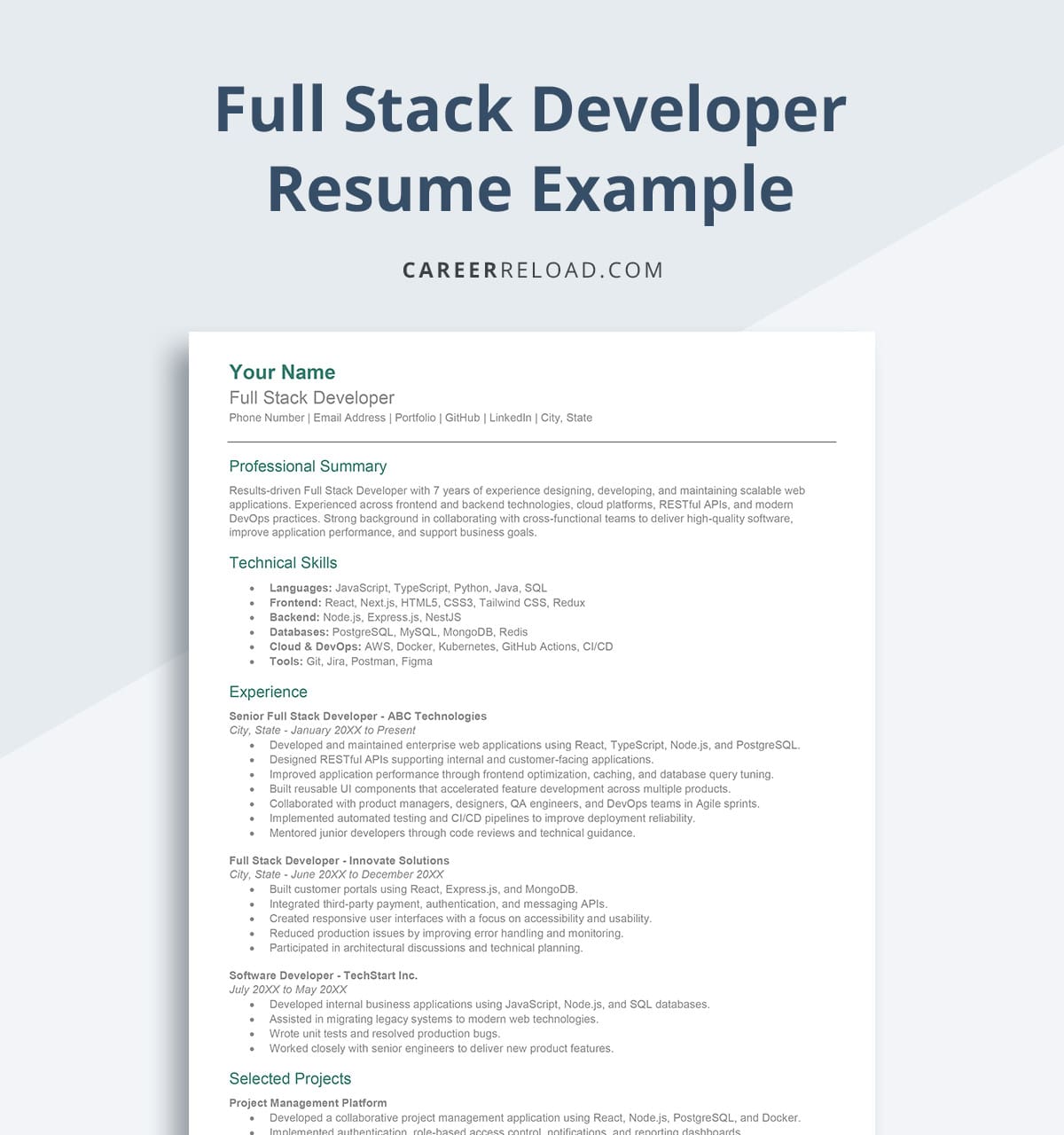
Full-stack developer resume example (copy-paste)
Your Name
Full Stack Developer
Phone Number | Email Address | City, State | Portfolio | GitHub | LinkedIn
Professional Summary
Results-driven Full Stack Developer with 7 years of experience designing, developing, and maintaining scalable web applications. Experienced across frontend and backend technologies, cloud platforms, RESTful APIs, and modern DevOps practices. Strong background in collaborating with cross-functional teams to deliver high-quality software, improve application performance, and support business goals.
Technical Skills
- Languages: JavaScript, TypeScript, Python, Java, SQL
- Frontend: React, Next.js, HTML5, CSS3, Tailwind CSS, Redux
- Backend:js, Express.js, NestJS
- Databases: PostgreSQL, MySQL, MongoDB, Redis
- Cloud & DevOps: AWS, Docker, Kubernetes, GitHub Actions, CI/CD
- Tools: Git, Jira, Postman, Figma
Professional Experience
Senior Full Stack Developer – ABC Technologies
City, State – January 20XX to Present
- Developed and maintained enterprise web applications using React, TypeScript, Node.js, and PostgreSQL.
- Designed RESTful APIs supporting internal and customer-facing applications.
- Improved application performance through frontend optimization, caching, and database query tuning.
- Built reusable UI components that accelerated feature development across multiple products.
- Collaborated with product managers, designers, QA engineers, and DevOps teams in Agile sprints.
- Implemented automated testing and CI/CD pipelines to improve deployment reliability.
- Mentored junior developers through code reviews and technical guidance.
Full Stack Developer – Innovate Solutions
City, State – June 20XX to December 20XX
- Built customer portals using React, Express.js, and MongoDB.
- Integrated third-party payment, authentication, and messaging APIs.
- Created responsive user interfaces with a focus on accessibility and usability.
- Reduced production issues by improving error handling and monitoring.
- Participated in architectural discussions and technical planning.
Software Developer – TechStart Inc.
July 20XX to May 20XX
- Developed internal business applications using JavaScript, Node.js, and SQL databases.
- Assisted in migrating legacy systems to modern web technologies.
- Wrote unit tests and resolved production bugs.
- Worked closely with senior engineers to deliver new product features.
Selected Projects
Project Management Platform
- Developed a collaborative project management application using React, Node.js, PostgreSQL, and Docker.
- Implemented authentication, role-based access control, notifications, and reporting dashboards.
E-commerce Platform
- Built scalable APIs for product catalog, shopping cart, payments, and order management.
- Integrated cloud storage and automated deployment workflows.
Education
Bachelor of Science in Computer Science
University of California
Certifications
- AWS Certified Developer
- Scrum Fundamentals Certified
Additional Information
- Strong experience with Agile software development.
- Excellent problem-solving and communication skills.
- Passionate about clean code, software architecture, and continuous learning.
Frequently asked questions
How do I group skills?
Group by layer. Cluster related tools so a scanner catches the important ones in a single glance. A front-end candidate might run separate groups for languages, frameworks, styling, and tooling. A back-end candidate might split languages, databases, and infrastructure. Lead each group with the tool the job posting names first, since that is the match a recruiter and an applicant tracking system both look for.
Must I list every framework?
No. List the frameworks the job asks for and the ones you can defend in an interview. A tight set reads as focus, while a wall of 40 tools reads as padding that the first technical screen will expose. If you have touched a framework once, leave it off the skills section or move it to a projects bullet where you can show the actual context.
Do personal projects really matter?
Yes, especially early in your career or during a career change. A project with a live link and a clean README proves you build things without being told to, which is exactly what a hiring manager cannot confirm from a job title alone. For entry-level candidates with thin work history, projects carry the resume. For senior candidates, one standout project is plenty and paid work should lead.
Do you need a portfolio or GitHub link on a developer resume?
Yes. Put both in the header. A live portfolio proves front-end work, and a GitHub with real commits proves you write code the way you say you do. For back-end candidates, a repo with a clean README and tests does more than a portfolio site would.
How many technical skills should you list?
Enough to cover the job posting, not so many that the list loses meaning. A focused set of 15 to 20 tools you can defend in an interview beats a wall of 40. Mirror the language of the job description so an applicant tracking system reads a match.
How do you show impact without confidential numbers?
Use percentages and ratios instead of raw figures. “Cut load time 60 percent” or “reduced query time by two thirds” tells the story without exposing anything private. Round where you need to, and never invent a number you cannot explain.
Final word
A developer resume earns one quick read before someone decides to keep going or move on. Make that read count with a clear role at the top, bullets built on real numbers, and a stack a reader can picture as one working product. Build the version for the job in front of you, then send it and track which one brings back interviews.

Alex is a career expert who specializes in resume writing and job search strategies. He focuses on sharing real-world tips that make work and job search feel more manageable.
Others also read
A Recruiter’s Advice on the Do’s and Don’ts of an Executive Resume
How to Ask For a Reference Letter
7 Job Search Metrics That Show What to Fix
How to Create a Social Media Strategy for Job Search
Medical Assistant Resume Example & Template
How to Write a Strong High School Letter of Recommendation
9 Reasons You Haven’t Landed a Job Yet
How to Customize your Resume for Different Industries
You Might Also Like These Free Templates
Resume Template in Word Document
Google Docs Resume Format – Debbie
Free Template for Resume
Free Resume Form Template
2 Column ATS Resume Template
ATS Friendly Resume Format for Word – Lindsay
Cover Letter Template with Monogram
Professional Cover Letter Template
Free Modern Resume Template for Word
Free Job Application Tracker for Excel
Free Resume Template Download for Word – Farrah
Free ATS-Friendly Resume Template – Emily