

Making a major professional leap is both an exciting and daunting endeavor. You have spent years building expertise, but when you look at job descriptions in your new desired field, it is easy to feel like an imposter. You might look at your past experience and worry that none of it makes sense for the roles you are targeting today. This is a common hurdle, but it is one you can absolutely overcome.
You do not need to start from scratch. Instead, you need to completely rebrand your existing experience. The ultimate tool for this rebranding process is a career transition resume. This specific type of document acts as a strategic marketing tool that bridges the gap between where you have been and where you want to go.
In this comprehensive guide, we will cover exactly how to format your application to your advantage. We will explore how to translate your existing talents, beat automated screening software, and look at real examples of successful pivots. By the end of this article, you will have the confidence and the blueprint needed to build a compelling narrative for your new professional chapter.
What makes a career change resume different from a traditional one?
A traditional application document is fairly straightforward. It proves you can do what you have already done by providing a historical record of your job titles and daily duties. However, a career change resume must accomplish something entirely different. It must prove you can do something new using your past experience as concrete evidence.
This requires a fundamental shift in how you present yourself on paper. Here are the primary differences you must understand:
- Focus on the future instead of the past: A standard timeline shows your progression in a single field. A switching industries resume highlights the overarching capabilities that make you a great fit for your next target role, framing past jobs merely as training grounds for your future career.
- Skill-centric rather than chronology-centric: Your previous job titles might confuse a recruiter in a new industry. By shifting the focus to high-level competencies, you force the hiring manager to look at what you can do rather than the specific title your previous employer gave you.
- A strong storytelling element: A career pivot requires a cohesive narrative that makes your industry switch look logical and intentional. If you simply hand a hiring manager a traditional timeline of unrelated jobs, your move will look completely random. You have to connect the dots for them.
Choosing the best resume format for changing industries
Selecting the right resume format is arguably the most critical step in your journey. Your layout dictates the first impression you make on a recruiter, and choosing the wrong one can result in instant rejection. Let us break down the three main options and identify the ultimate career pivot resume format.
- The chronological format: This is the most common style globally, but it is the one you should generally avoid when changing industries. By listing your work history in reverse chronological order right at the top, you immediately highlight the exact experience you lack. Recruiters will see your current unrelated title and often move on to the next candidate.
- The functional format: This layout is often recommended for career changers, but you must proceed with extreme caution. This format completely hides your work history behind massive blocks of skills. While it sounds great in theory, many recruiters and hiring managers actively dislike the functional layout because it can look evasive. It makes them wonder what you are trying to hide regarding your employment dates.
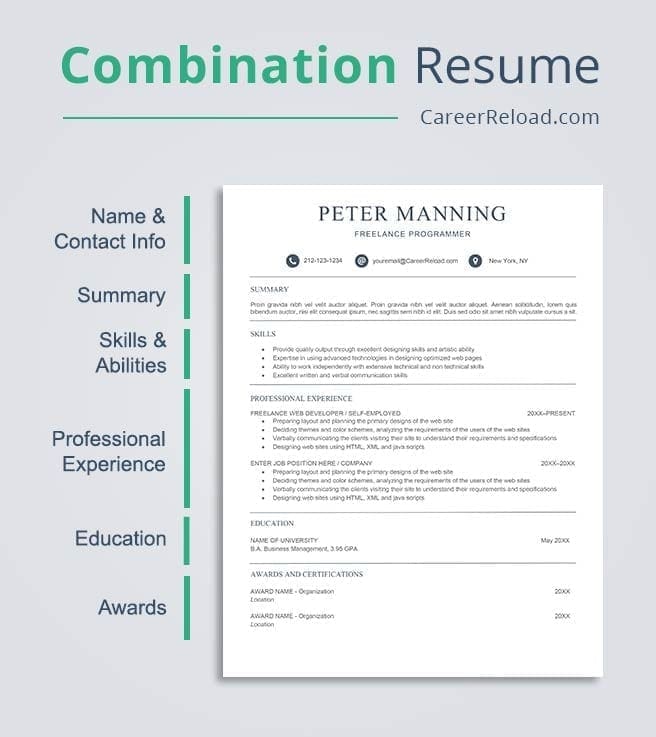
- The hybrid or combination format: This is the absolute golden standard for a career transition resume. This layout gives you the best of both worlds. It leads with a robust, highly visible skills and achievements section at the top of the page. This immediately hooks the reader with your relevant abilities. Then, it follows up with a condensed work history section to satisfy the recruiter’s need to see a clear timeline of employment.
Writing a compelling professional summary that bridges the gap
The top third of your document is prime real estate. If you do not capture a recruiter’s attention here, they will not read the rest of the page. This is where your professional summary comes into play.
First, you must completely ditch the outdated objective statement. Saying you are a hard worker looking for a job in a new field tells the company nothing about the value you bring. It focuses entirely on your needs rather than the employer’s needs.
Instead, you must craft a new elevator pitch that bridges the gap. A compelling summary for a switching industries resume is three to four sentences long. It clearly states who you are, outlines the unique value proposition you bring from your previous career, and explains how those traits will directly benefit your new target industry.
Keyword integration is also vital here. You should drop the core keywords of your new industry right at the top of your professional summary. If you are moving into digital marketing, words like campaign strategy, audience engagement, and data analytics should appear in this opening paragraph. This signals to both human readers and automated systems that you belong in this field.
Identifying and translating your transferable skills
The foundation of a strong career change application lies in your ability to identify and showcase transferable skills. These are the core competencies you have developed over your working life that are valuable in almost any profession. Excellent examples include team leadership, complex problem solving, project management, data analysis, and client relations.
To make a transferable skills resume work, you must complete a deliberate translation exercise. You need to look at your current skill set and map it to the specific terminology of the new industry. Different fields use different words for the exact same task. Here are a few examples of how to translate your skills:
- If you are leaving the healthcare sector where you handled patient intakes, you are essentially doing client onboarding. If you are moving into software as a service, change your phrasing to client onboarding to match their language.
- If you are a teacher who creates lesson plans and presents them to students, you are actually doing curriculum development, instructional design, and public speaking.
- If you work in retail dealing with angry shoppers, you possess high-level conflict resolution and customer success skills.
Once you have translated these abilities, create a dedicated skills section on your document. Place this prominently on the first page. Categorize your abilities into relevant buckets to make it easy for the recruiter to skim.
Revamping your work experience section to ditch old jargon
Once you have established your skills, you must tackle the work experience section. This is where many career changers stumble because they rely heavily on old, industry-specific jargon. You can fix this by following a few vital steps.
First, audit your past responsibilities. You need to mercilessly cut bullet points that might be incredibly impressive in your old field but hold zero relevance to your new one. If you are an accountant moving into graphic design, the fact that you mastered a specific tax compliance software does not matter anymore. Remove it to save space for relevant achievements.
Next, rewrite your remaining bullet points for your new audience. You must take hyper-specific jargon and turn it into universally understood business achievements. Focus on universal metrics like time saved, revenue generated, or efficiency improved.
To do this effectively, use the XYZ formula. This formula forces you to state that you accomplished X as measured by Y by doing Z. By focusing on impact and measurable results rather than daily duties, you prove your competence. A bullet point that reads “Increased departmental efficiency by 15 percent by redesigning the weekly reporting process” is universally impressive, regardless of the industry in which it was achieved.

Highlighting new education, certifications, and relevant projects
When you are switching fields, your recent educational efforts might actually be more relevant than your last five years of work history. Highlighting new education, certifications, and relevant projects correctly is a crucial component of your career transition resume.
Strategic placement is everything. If you just completed an intensive bootcamp, earned an MBA, or acquired a major certification specifically for your new target industry, you should move the education and certification section to the top of your resume. Placing it right below your professional summary shows recruiters you have recent, formalized training in their field.
Showcasing continuous learning is a powerful way to support your transition narrative. It proves to employers that you are serious about this pivot and willing to invest your own time and resources into getting up to speed.
Additionally, leveraging personal projects and freelance work can easily fill gaps in your professional experience. You can list unpaid work, portfolio projects, or strategic volunteering as valid experience. Create a section titled Relevant Projects to showcase these endeavors. This builds immediate credibility and gives hiring managers tangible proof of your abilities.
Optimizing your career transition resume for applicant tracking systems (ATS)
Before a human ever reads your application, it must pass through an Applicant Tracking System. These software programs scan your document for specific criteria, and optimizing your file for these systems is an absolutely mandatory step.
The main challenge of the ATS for career changers is that the software looks for direct, exact matches. If a system is programmed to look for the job title of Financial Analyst and your current title is High School Math Teacher, the software might automatically reject you. This puts career pivots at a distinct disadvantage. To combat this, you must optimize your document by doing the following:
- Mine job descriptions for keywords: Gather three to five job postings for the roles you want. Scan them carefully for hard skills, soft skills, and exact phrasing.
- Mirror the exact language: If the job description asks for cross-functional collaboration, do not write that you worked with different departments. You must mirror their exact phrasing so the ATS recognizes the match.
- Format for readability: It is tempting to use overly designed templates with fancy graphics, progress bars, or multiple complex columns to stand out. You must avoid this completely. Complex formatting confuses ATS bots, causing them to scramble your text or reject your application. Keep the layout clean, text-based, and highly structured.
Here are a few ATS-friendly resume templates you can download for free:


Real-world career transition resume examples and templates
Understanding the theory behind a career change resume is helpful, but seeing it applied in real-world scenarios brings the concepts to life. Let us look at how professionals in vastly different fields can pivot their narratives successfully.
Scenario A: Teacher to corporate trainer or instructional designer
In a traditional format, a teacher might list duties like managing a classroom of thirty students, writing daily lesson plans, and communicating with parents. In a transitioning format, this needs a corporate spin. Managing a classroom becomes facilitating daily training sessions for large groups. Writing lesson plans becomes designing and implementing comprehensive training curricula. Communicating with parents translates to providing stakeholder updates and performance reporting.
Scenario B: Sales to tech as a customer success manager
In sales, the focus is often strictly on quota-crushing metrics and transactional revenue. To pivot into customer success, the document must shift to highlight relationship building and retention. A bullet point about aggressively upselling products can be translated to managing a portfolio of high-value accounts and driving product adoption. The focus shifts to metrics related to customer satisfaction scores, churn reduction, and long-term client retention.
Creating your own version of these examples is easier when you use a proven framework. Finding a template that utilizes the hybrid format is your best starting point. Look for standard, clean designs that prioritize a robust summary and skills section at the top, allowing you to seamlessly integrate your own translated achievements.
Conclusion: Taking the leap with confidence
Making a major professional shift requires courage, strategy, and a completely redefined approach to how you present your professional self.
To recap the main takeaways, remember that the hybrid layout is your most powerful asset. It allows you to lead with your strengths while still providing the necessary employment timeline. You must actively translate your transferable skills using the exact language of your target industry. Furthermore, tailoring your narrative to focus on your universal business impact using the XYZ formula will ensure your past achievements resonate with future employers.
A final word of encouragement is necessary. Do not view your diverse background as a liability. Many companies actively seek out individuals with non-traditional backgrounds because they bring fresh perspectives, diverse problem-solving approaches, and incredible adaptability. Your past experience is a massive asset when framed correctly on a career transition resume.
Take the time to audit your current application document and apply these strategies today. If you are ready to take the leap, leave a comment below with the industries you are transitioning between. Sharing your goals is the first step toward making your career pivot a reality.

Sara has been in the career development field for over 10 years and has a wealth of knowledge to share. She covers topics such as resume writing, job search strategies, interview techniques, career planning, and more. She has curated our free downloadable resume templates for Word and resume templates for Google Docs.
Others also read
7 Benefits of Using a Recruitment Agency in Your Job Search
How to Quit a Job
Bookkeeper Resume Examples and Templates
How to Build a Resume for Free
How to Check if Your CV is ATS-Friendly
Resume Genius vs Career Reload: Which Is the Best Choice for Job Seekers?
Why Your Resume Needs Project Management Skills
Cybersecurity Resume Examples, Template & Writing Guide
You Might Also Like These Free Templates
Resume Template in Word Document
Google Docs Resume Format – Debbie
Free Template for Resume
Free Resume Form Template
2 Column ATS Resume Template
ATS Friendly Resume Format for Word – Lindsay
Cover Letter Template with Monogram
Professional Cover Letter Template
Free Modern Resume Template for Word
Free Job Application Tracker for Excel
Free Resume Template Download for Word – Farrah
Free ATS-Friendly Resume Template – Emily