

Where do you see yourself in five years?
This question often creates anxiety during job interviews and performance reviews. Most people dislike it because they live their professional lives on autopilot. They react to urgent emails and deadlines instead of proactively steering their careers.
A 5-year plan acts as a compass rather than a crystal ball. It provides direction when you feel lost and helps you filter opportunities that do not align with your long-term vision.
Research backs up the importance of planning. A study by Dominican University of California found that individuals who write down their goals are 42% more likely to achieve them than those who do not.
This guide provides a comprehensive framework to build a career roadmap. You will move from vague aspirations to a concrete professional development strategy that adapts to real-world changes.
Phase 1: The audit (start with where you are)
You cannot map a route to a new destination without first identifying your current location. Many professionals skip this step and jump straight to setting goals. This often leads to plans that look good on paper but fail in reality because they ignore current constraints or dissatisfactions.
Analyze your current reality
Start by conducting a factual assessment of your professional life today. Avoid judgment and simply list the data points.
- Current Role: What is your official title and what are your actual responsibilities?
- Compensation: List your salary, benefits, and any equity.
- Satisfaction Level: Rate your job satisfaction on a scale of 1 to 10.
- Work-Life Balance: How many hours do you realistically work per week?
This inventory highlights immediate pain points. If your satisfaction score is low, you need to understand why before you plan the next five years.
The “anti-goals” list
Defining what you want is sometimes harder than defining what you do not want. An “anti-goal” list clarifies the things you want to leave behind as you progress.
Common anti-goals include:
- Commuting more than 30 minutes.
- Working on weekends.
- Managing a team larger than five people.
- Working in a culture that discourages remote work.
Knowing what you want to avoid prevents you from climbing a ladder you eventually resent.
Values alignment
A sustainable professional development plan must align with your personal values. The Japanese concept of Ikigai suggests that fulfillment comes from the intersection of four areas: what you love, what you are good at, what the world needs, and what you can be paid for. For the auditing phase you might also consider taking a personality test.
Review your current role against these four pillars. If you have high pay but low passion, your 5-year plan should prioritize finding work that interests you. If you have high passion but low pay, your plan must focus on financial growth or monetization skills.
Phase 2: Define the “north star” (the year 5 vision)
Your Year 5 goal is your “North Star.” It guides your decisions even when the path is not clear.
The visualization exercise
Imagine a typical Tuesday exactly five years from today. Do not focus on the job title yet. Focus on the environment and the work itself.
Write down the answers to these questions:
- Who are the people around you? Are you leading them or working independently?
- What primary problem are you solving for your company or clients?
- What does your physical workspace look like?
- How much free time do you have?
Turn the vision into a metric
Vague aspirations do not lead to progress. You must convert your vision into concrete long-term career goals.
- Vague: “I want to be a leader in the tech industry.”
- Specific: “I want to be a VP of Product at a mid-sized SaaS company earning $200,000 annually.”
- Vague: “I want to work for myself.”
- Specific: “I want to own a digital marketing consultancy with five recurring clients and zero debt.”
Specific metrics allow you to measure progress. They turn a dream into a target.
Phase 3: The timeline breakdown (reverse engineering)
A five-year gap is too large to manage in one step. You must use strategic career planning to reverse engineer the path from your future self back to today.
Year 5: The destination
This is the specific metric you defined in Phase 2. All previous years serve this final outcome.
Year 4: The polishing phase
By Year 4, you should be qualified for your Year 5 goal. This year is about visibility and positioning. You might focus on speaking at industry conferences, publishing thought leadership, or mentoring junior employees to demonstrate leadership potential.
Year 3: The pivot point
Year 3 often requires the biggest leap. This is the midway milestone where you might change companies, earn a major certification, or accept a stretch assignment. If your Year 5 goal requires management experience, Year 3 is when you must secure your first team lead role.
Years 1-2: The foundation
The first two years are for construction. You need to acquire the raw materials for your future success. This involves learning hard skills, building your professional network, and fixing the weaknesses identified in your audit.
The 6-month sprint
A 5-year plan is useless if you do not know what to do on Monday morning. Break down your Year 1 goals into a 6-month sprint.
- Register for the necessary course.
- Update your LinkedIn profile.
- Schedule coffee chats with three people in your desired field.
Phase 4: Identify the skills gap
The gap between your current reality and your Year 5 vision is usually a skills gap. You need to identify what you must learn to bridge that distance.
Hard skills vs. soft skills
The World Economic Forum’s Future of Jobs Report 2025 highlights a critical trend: 50% of all employees will need reskilling by 2025. The report also notes that critical thinking and problem-solving top the list of skills employers believe will grow in prominence.
- Hard Skills: These are technical abilities. For a marketer, this might be data analytics or Python. For a project manager, this might be PMP certification.
- Soft Skills: These are interpersonal traits. Negotiation, emotional intelligence, and public speaking are often what separate mid-level employees from executives.

The resource check
Once you identify the missing skills, list the resources required to acquire them.
- Education: Do you need a formal degree, a bootcamp, or online courses?
- Experience: Do you need to volunteer for a specific project at work to get hands-on practice?
- Network: Who already has the job you want? You need to know them.
Including specific skill acquisition in your 5-year career plan examples ensures your goals are realistic and grounded in market demand.
Phase 5: Formatting and documenting your plan
A plan that exists only in your head is just a daydream. You must document it.
Choose your vessel
The format matters less than the accessibility. You need a tool that you will look at regularily.
- Digital Tools: Trello, Asana, and Notion are excellent for people who like to move “cards” from “To Do” to “Done.” A simple Google Sheet works well for tracking metrics like income or savings.
- Analog Tools: A physical notebook or a whiteboard in your home office serves as a constant visual reminder.
The SMART goals framework
Ensure every milestone in your plan follows the SMART criteria.
- Specific: Clear and unambiguous.
- Measurable: You can track it with numbers.
- Achievable: Realistic given your resources.
- Relevant: Aligns with your Year 5 North Star.
- Time-bound: Has a firm deadline.
Example: Instead of “Network more,” write “Connect with two industry peers on LinkedIn every Friday for the next three months.”
Phase 6: The agility factor
Life rarely follows a straight line. Industries change, personal circumstances shift, and new technologies emerge. A rigid plan breaks under pressure, but an agile plan adapts.
The 80/20 rule of planning
Treat 80% of your plan as a firm direction and 20% as flexible room for experimentation. This buffer allows you to say yes to unexpected opportunities that might accelerate your progress, even if they were not in the original document.
How to pivot
Changing your plan does not mean you failed. It means you are paying attention. If you planned to become a journalist but the industry shrinks, pivoting to content marketing or PR is a strategic move, not a defeat.
According to LinkedIn’s 2024 Workplace Learning Report, 94% of employees say they would stay at a company longer if it invested in their learning. If your current employer stops offering growth, your plan dictates that you must find one that does.
The quarterly review
Set a recurring calendar appointment every 90 days to review your career roadmap. Ask yourself three questions:
- Am I on track to hit my Year 1 goals?
- Do I still want the Year 5 goal?
- What new skills do I need to learn based on industry changes?
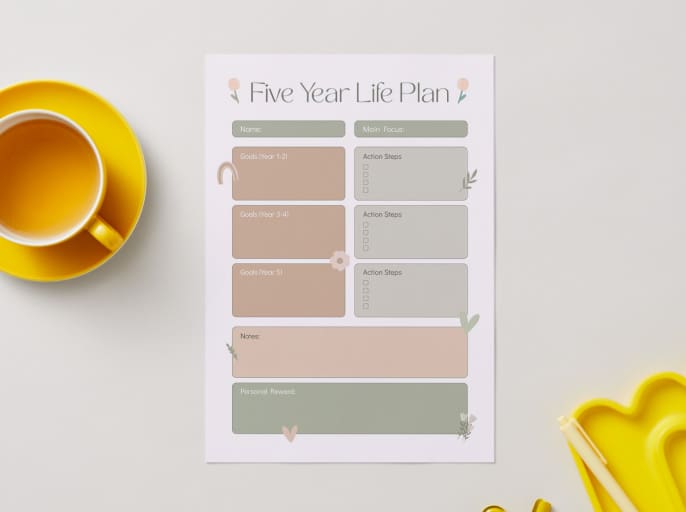
5-year plan template
Here’s a simple template you can use to create your 5-year plan.
| Year 1 | Year 2 | Year 3 | Year 4 | Year 5 | |
| Professional development | |||||
| Career | |||||
| Financial | |||||
| Health | |||||
| Other |
Here are some templates you can use:


Common mistakes to avoid
Even with a solid framework, many people stumble due to psychological traps.
Setting goals based on others’ expectations
This is the “prestige trap.” Do not plan to become a CEO just because it sounds impressive. If you value free time and low stress, a high-pressure executive role will make you miserable. Your plan must serve you, not your parents or your peers.
Ignoring the personal life aspect
You cannot separate your career from your life. A plan that requires 80-hour work weeks is destined to fail if you also plan to start a family or train for a marathon during the same period. Your professional goals must coexist with your personal health and relationships.
Vague language
Avoid words like “better,” “more,” or “soon.” These words hide a lack of commitment. “Get better at public speaking” is weak. “Join Toastmasters and give four speeches this year” is strong.
Lack of accountability
We often break promises we make to ourselves. Share your plan with a mentor, a partner, or a peer group. The Dominican University study mentioned earlier proved that sending weekly progress reports to a friend increases goal achievement significantly.
Questions and Answers
How often should I update my 5-year plan?
You should review your plan quarterly (every three months) to track progress. You should perform a major overhaul or “deep dive” review once a year to ensure your long-term vision still aligns with your values.
Is a 5-year plan necessary for every career?
Yes, some form of planning is helpful for every professional. While creative or freelance careers may require more flexibility than corporate roles, having a defined direction helps everyone prioritize their time and resources effectively.
What if I change my mind about my career goal?
Changing your mind is normal and healthy. A 5-year plan is a living document, not a binding contract. If you discover a new passion or the market changes, you should update your plan to reflect your new direction.
How do I start a 5-year plan if I don’t know what I want?
Start with the “Audit” phase described in this article. Focus on what you do not want (anti-goals) and what skills you currently enjoy using. specific short-term goals often reveal the long-term path over time.
Conclusion
The best time to plant a tree was 20 years ago. The best time to start your five-year plan is today.
You do not need to have all the answers right now. You only need a rough draft. A messy plan is infinitely better than no plan because it gives you a baseline to improve.
Take action now. Set a timer for 30 minutes. Turn off your notifications. Open a blank document or grab a sheet of paper. specific Steps: 1. Audit your current role. 2. Write down your Year 5 vision. 3. List the skills you are missing.
Your future self is waiting for you to take the wheel.

Alex is a career expert who specializes in resume writing and job search strategies. He focuses on sharing real-world tips that make work and job search feel more manageable.
Others also read
How to Highlight Volunteer Experience on Your Resume
How to Write an Efficient Software Engineer Resume
How to Ask For a Reference Letter
Software Developer Resume Example to Land Your Dream Tech Job
How to Choose the Right Resume Template
Pharmacy Technician Resume Examples and Writing Guide
Zety Review: Templates & Resume Builder
A 5 Step Guide to Finding an Internship During College
You Might Also Like These Free Templates
Resume Template in Word Document
Google Docs Resume Format – Debbie
Free Template for Resume
Free Resume Form Template
2 Column ATS Resume Template
ATS Friendly Resume Format for Word – Lindsay
Cover Letter Template with Monogram
Professional Cover Letter Template
Free Modern Resume Template for Word
Free Job Application Tracker for Excel
Free Resume Template Download for Word – Farrah
Free ATS-Friendly Resume Template – Emily