

One of the most notable sections that employers evaluate for a prospective employee’s resume is the skills section. They pay particular attention to the skills as these could be the greatest indicator of what an individual can bring to the company, and therefore a determinant in whether you move ahead in the hiring process. This guide shows you which soft and hard skills to put on your resume, where to place them for maximum impact, and how to prove each one so a hiring manager takes you seriously.
What are hard skills
Hard skills are the specific, teachable, and measurable abilities you use to perform tasks on the job. You gain them through school, training programs, certifications, or hands-on work experience, and you can usually prove them with a test, a portfolio, or a credential. Coding in Python, running paid ads, closing books in QuickBooks, editing video in Premiere Pro, or drafting a floor plan in AutoCAD are all hard skills.
Every job leans on a set of hard skills that keep the work running. Nurses need to read vitals and administer medication. Financial analysts need to build models in Excel. Chefs need knife skills and food safety knowledge. When a job posting says “must have three years of experience with Salesforce,” that is a hard skill requirement.
Examples of in-demand hard skills
- Data analysis and SQL
- Programming (Python, Java, JavaScript, C++)
- Cloud computing (AWS, Azure, Google Cloud)
- Cybersecurity
- AI and machine learning
- Prompt engineering and AI workflow design
- Web development (HTML, CSS, JavaScript frameworks)
- Mobile app development (iOS, Android)
- UI/UX design
- SEO and SEM
- Digital marketing and campaign management
- Copywriting and content creation
- Video production and editing
- Financial modeling and forecasting
- Bookkeeping and accounting software (QuickBooks, Xero)
- CRM platforms (Salesforce, HubSpot)
- Project management methodologies (Agile, Scrum, Kanban)
- Applicant Tracking System (ATS) administration
- Foreign language proficiency
- Statistical analysis (R, SPSS, SAS)
The demand for each skill shifts by industry, region, and role. Before you finalize your resume, scan five to ten job postings for your target position and note the technical requirements that show up more than once. Those are the top skills for the resume you should feature.
What are soft skills
Soft skills are the personal habits, traits, and interpersonal abilities that shape how you work with others and handle your responsibilities. Sometimes called people skills or human skills, they are harder to measure than hard skills and less tied to a specific role. Someone with strong soft skills can communicate a difficult idea, keep a team on track through a tight deadline, or defuse a conflict without losing momentum.
Soft skills travel with you across industries and job titles. A registered nurse who moves into medical device sales still relies on empathy, active listening, and clear communication. A software engineer who shifts into product management still uses collaboration and problem-solving every day. That portability is why soft skills are highly transferable and worth listing on almost any resume.
Examples of in-demand soft skills
- Communication (written and verbal)
- Active listening
- Collaboration and teamwork
- Problem-solving
- Critical thinking
- Adaptability
- Leadership
- Time management
- Creativity
- Emotional intelligence
- Decision-making
- Conflict resolution
- Negotiation
- Empathy
- Resilience
- Attention to detail
- Presentation skills
- Customer service orientation
- Cross-functional collaboration
- Coaching and mentoring
Soft skills sharpen hard skills. A data analyst who can explain findings to a marketing team clearly is more valuable than one who cannot. That is why employers look for both.
Pro Tip:
Use a resume builder to create an optimized resume in no time. Creating a resume has never been this easy!
Hard skills vs soft skills at a glance
The two categories work together, but they behave differently in how you build them and how you prove them. This side-by-side view makes the difference concrete.
| Hard skills | Soft skills |
| Technical and role-specific | Behavioral and interpersonal |
| Learned through school, training, or certifications | Built through experience, feedback, and practice |
| Measurable and testable (exam, portfolio, credential) | Shown through behavior and results |
| Tied to a job function (e.g., SQL for analysts) | Transferable across roles (e.g., communication) |
| Easier to list on a resume with proof | Best proven through examples and outcomes |
| More vulnerable to automation over time | Growing in value as AI handles routine tasks |
Most jobs need a blend. A sales rep needs CRM fluency (hard) and negotiation (soft). Your resume should reflect both, weighted toward the job you’re applying for.
Do employers care more about hard skills or soft skills
Both, and the mix shifts by role. Hard skills are the entry ticket. If a job needs Python, you either have Python or you don’t. Miss the ticket, miss the interview. But once candidates clear the technical bar, soft skills usually decide who gets the offer. Understanding how the two skill types reinforce each other helps you present both credibly.
The National Association of Colleges and Employers’ career readiness competencies consistently rank problem-solving, teamwork, and communication among the attributes employers most want to see on a new hire’s resume. That pattern holds year after year. The takeaway is simple. Lead with the hard skills the job posting names, then use your work history and summary to demonstrate the soft skills that matter for the role.
How to identify your strongest hard and soft skills
Before you list anything, get honest about what you actually have. Guessing wastes space on your resume and shows up in the interview when you can’t back a claim. Use these approaches to build a solid list.
Reflect on past wins
Think back to projects where things went well. What did you do that others couldn’t or didn’t? What did managers, teammates, or clients thank you for? A pattern of praise around one behavior (organization, calm under pressure, quick learning) usually points to a real soft skill. A repeated technical contribution (rebuilding a broken spreadsheet, writing the team’s SQL queries) points to a real hard skill.
Mine your job descriptions
Pull three to five job postings for the role you want next. Copy every skill they list into a single document. Highlight the ones you already have with proof. Circle the ones you’re close to and could sharpen. Ignore the ones that are far off for now. This exercise doubles as resume keywords research, since applicant tracking systems and recruiters are looking for those exact terms.
Ask people who’ve worked with you
Send a short message to two or three former managers, colleagues, or clients. Ask them what you brought to the team and what problems they’d bring to you first. Outside perspective catches strengths you take for granted and blind spots you can’t see yourself.
Review your performance evaluations
Past performance reviews often name your strengths in plain language. Look for repeated phrases across evaluations. Those are the soft and hard skills you should already be leading with.
Take a skills assessment
Structured assessments like CliftonStrengths, the Myers-Briggs Type Indicator, or role-specific technical tests on HackerRank, Coursera, or LinkedIn Learning give you a benchmark. Use them as data points, not verdicts. They work best when you cross-reference them with your own reflection and the feedback you’ve gathered. This is also useful for identifying and assessing your skills gaps.

Where to put soft and hard skills on your resume
Skills belong in more than one place. A dedicated skills section alone gets skimmed. Weaving your skills through the resume gives hiring managers proof at every stop.
Professional summary
Your summary or objective statement sits at the top and is often the first thing read. Use it to spotlight one to two soft skills and one to two hard skills that line up with the job.
Example for a data analyst role: Data analyst with five years of experience turning raw data into decisions for e-commerce teams. Skilled in SQL, Python, and Tableau, with a track record of translating technical findings for non-technical stakeholders.
That single sentence carries three hard skills (SQL, Python, Tableau) and two soft skills (communication and cross-functional collaboration).
Work experience section
The work experience block is where you prove skills instead of just naming them. Each bullet should show a skill in action with a measurable result.
Weak bullet:
- Responsible for team communication and reporting.
Strong bullet:
- Led weekly cross-functional standups with product, engineering, and marketing, cutting release delays by 30% over two quarters.
The second version proves communication, leadership, and collaboration without naming any of them. Pair every bullet with an action verb at the front and a result at the end.
Skills section
Create a dedicated block near the top of the resume, usually right after your summary. Split it into two subsections so a recruiter can find both types quickly.
Hard skills
- Programming: Python, SQL, R
- Data visualization: Tableau, Power BI, Looker
- Cloud: AWS (Certified Solutions Architect), GCP
- Project management: Jira, Agile methodology
Soft skills
- Cross-functional collaboration
- Stakeholder communication
- Analytical problem-solving
- Coaching junior analysts
Tailor this section to the role. Move the skills the job posting mentions to the top. Cut skills that don’t apply.
Some resume templates make this easier than others.
This modern resume template with skills section gives soft and hard skills their own clear block:
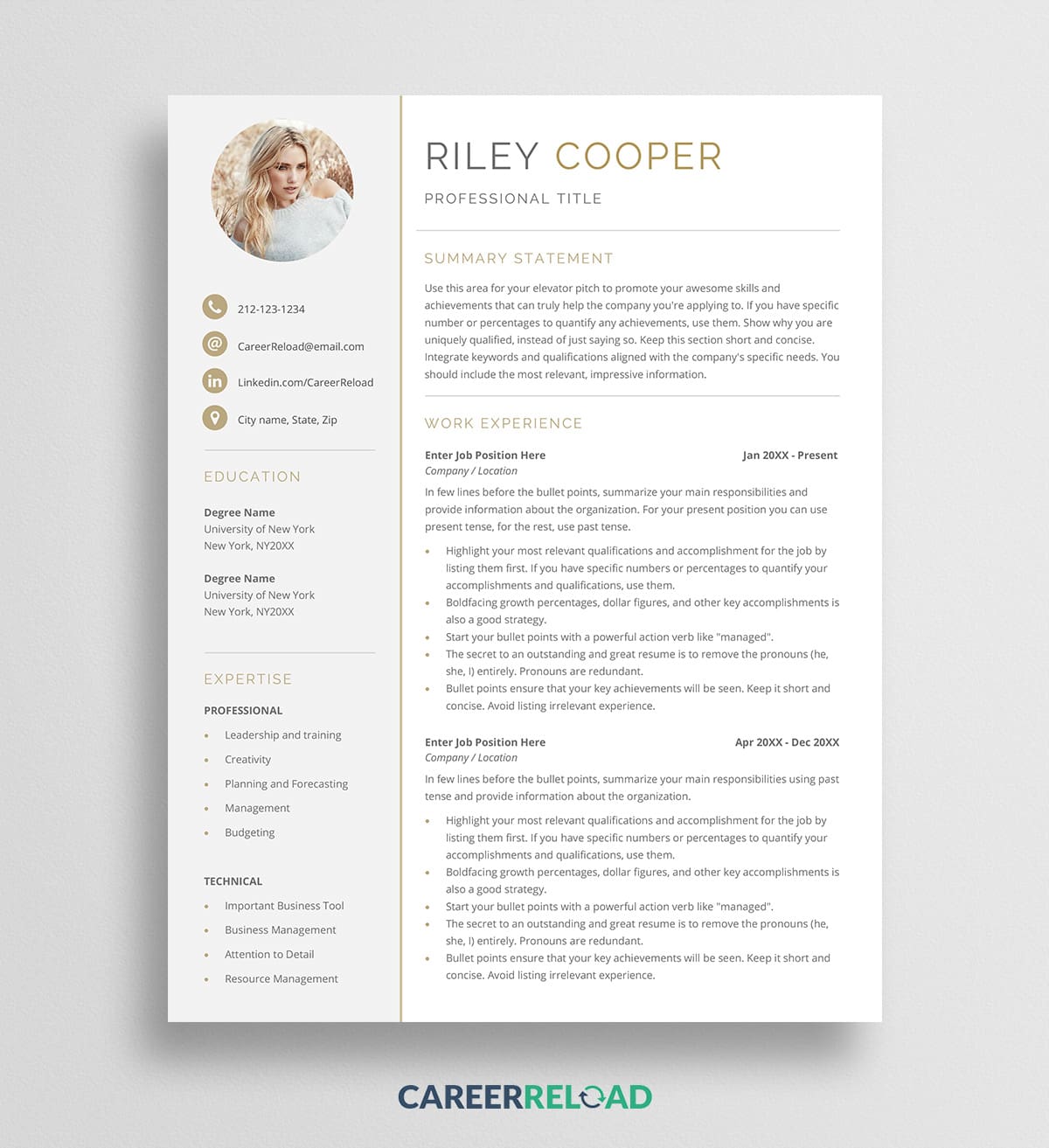
The ATS-friendly resume template with a skills section uses a single-column layout that parses cleanly through applicant tracking systems.

Education and certifications
Certifications validate hard skills better than any bullet in the skills section. If you hold PMP, AWS Certified Cloud Practitioner, Google Analytics certification, HubSpot Inbound, or a SHRM credential, list it. Coursework that maps to a role (Advanced SQL, Financial Modeling, Data Structures) belongs here too.
Hard and soft skills examples by role
Different jobs need different blends. The table below shows how soft and hard skills combine for a handful of roles. Use it as a starting point, then customize based on the specific posting you’re targeting.
| Role | Core hard skills | Core soft skills |
| Software engineer | Python, Git, system design, SQL | Collaboration, problem-solving, code review feedback |
| Marketing manager | SEO, Google Analytics, HubSpot, copywriting | Strategic thinking, cross-functional collaboration, storytelling |
| Registered nurse | Patient assessment, IV administration, EMR (Epic) | Empathy, active listening, calm under pressure |
| Financial analyst | Excel modeling, financial forecasting, SQL | Attention to detail, analytical thinking, executive communication |
| UX designer | Figma, user research, prototyping, accessibility standards | Empathy, cross-functional collaboration, presentation skills |
| Project manager | Jira, Agile, Scrum, budget tracking | Leadership, negotiation, stakeholder communication |
| Sales representative | Salesforce, cold outreach, sales pipeline management | Persuasion, active listening, resilience |
| HR generalist | ATS platforms, employment law, HRIS (Workday) | Discretion, conflict resolution, empathy |
| Data analyst | SQL, Python, Tableau, statistical analysis | Curiosity, communication, business acumen |
Use this as a scaffold, not a script. If the posting you’re applying to lists specific tools, replace the ones in the table.
How to prove your soft and hard skills with the STAR method
Listing skills is easy. Proving them is what wins interviews. The STAR method gives you a structure to turn each bullet on your resume into a mini case study a hiring manager can trust.
- Situation. Set the scene in one line. What was the context?
- Task. What were you responsible for? What was at stake?
- Action. What did you specifically do? Use action verbs.
- Result. What changed because of your work? Add a number when you can.
Example applied to a resume bullet showing leadership and analytical skills:
- Rebuilt the monthly financial reporting process for a 15-person finance team, cutting close time from nine days to four and freeing capacity for two new business initiatives.
That one line covers project leadership, process improvement, and financial reporting. It also gives the interviewer three natural follow-up questions to walk through in the interview. The STAR method also works during interview prep, since the same structure keeps your answers focused and specific. For career change resumes, STAR is especially useful because it lets you frame past accomplishments in language that maps to the new role.
How to build new soft and hard skills
If you’re missing a skill the job needs, you have options. Hard skills usually respond well to structured learning. Soft skills grow through practice, feedback, and reflection.
To build hard skills
- Take online courses on Coursera, edX, LinkedIn Learning, or Udemy that lead to a certificate you can list.
- Pursue industry credentials (PMP for project management, CFA for finance, AWS for cloud, SHRM-CP for HR).
- Work on a small project or freelance gig to apply the new skill and build a portfolio.
- Ask your current employer for a stretch assignment that lets you use the skill on paid time.
To build soft skills
- Volunteer for a project outside your usual scope. Leading a cross-team initiative sharpens collaboration and communication faster than any course.
- Ask for direct feedback after meetings, presentations, and difficult conversations.
- Find a mentor who’s strong where you want to grow. A monthly conversation compounds over a year.
- Practice one skill at a time. Trying to overhaul five habits at once dilutes the effort.
Frequently asked questions about soft and hard skills
How many hard and soft skills should I list on my resume?
Aim for five to ten hard skills and four to seven soft skills, all tailored to the job you’re applying for. More than that starts to look like keyword stuffing. Prioritize the skills the job posting names first, then add the ones you can back up with clear examples in your work history.
Are soft and hard skills the same as resume keywords?
Yes, both are treated as resume keywords by hiring managers and applicant tracking systems. When a job posting emphasizes “Python programming” and “cross-functional communication,” those exact phrases should appear in your resume, ideally in the skills section and again in your work history bullets.
Should hard skills or soft skills come first on a resume?
Hard skills usually come first in the dedicated skills section because they’re the entry requirements a recruiter scans for. Soft skills often work better inside the professional summary and work experience bullets, where you can show them through action and results rather than as a plain list.
What’s the difference between hard skills and action verbs?
Hard skills are the technical abilities you have. Action verbs are the words you use to describe what you did with those abilities. “Data analysis” is a hard skill. “Analyzed,” “modeled,” and “forecasted” are the action verbs that bring it to life in a bullet point. Both belong on a strong resume.
Can soft skills be learned?
Yes. Soft skills grow through deliberate practice, feedback from people you work with, mentorship, and structured training. They develop more slowly than hard skills, but they respond to the same principles. Focus on one skill at a time, get honest feedback often, and put yourself in situations that stretch you.
Which soft skills matter most in an AI-heavy workplace?
Critical thinking, creativity, adaptability, and emotional intelligence rank at the top. Routine analysis, drafting, and reporting tasks are increasingly handled by AI tools. The skills that hold their value are the ones tied to judgment, relationships, and framing the right questions in the first place.
Final Words
A strong resume mixes soft and hard skills the way the job actually mixes them. Lead with the hard skills the posting names, prove your soft skills through results in your work history, and use the STAR method to turn each bullet into evidence. Tailor the mix for every application. The same base resume with a different top-of-page skill block often makes the difference between an ATS filter-out and an interview slot.
For more on shaping the rest of your resume, browse Career Reload’s Resume Tips library and the word resume templates collection.
Pin/share/bookmark this post for later:


Sara has been in the career development field for over 10 years and has a wealth of knowledge to share. She covers topics such as resume writing, job search strategies, interview techniques, career planning, and more. She has curated our free downloadable resume templates for Word and resume templates for Google Docs.
Others also read
How to Stay Motivated Through Slow Hiring Season
How to Take Advantage of Quiet Hiring as an Employee
What Can You Learn From The Resumes of These 3 Famous People
9 Office and Administration Resume Templates and Examples for 2026
How to Create a Resume in Apple Pages (Step-by-Step Guide)
Boost Your Resume with Certifications That Impress Employers
The Power of Recommendation Letters in Your Job Search
Personal Assistant Resume Examples and Writing Guide
You Might Also Like These Free Templates
Resume Template in Word Document
Google Docs Resume Format – Debbie
Free Template for Resume
Free Resume Form Template
2 Column ATS Resume Template
ATS Friendly Resume Format for Word – Lindsay
Cover Letter Template with Monogram
Professional Cover Letter Template
Free Modern Resume Template for Word
Free Job Application Tracker for Excel
Free Resume Template Download for Word – Farrah
Free ATS-Friendly Resume Template – Emily