

To write a career change resume, lead with a resume objective or summary that connects your past experience to the new role, choose a combination format that puts skills before work history, and translate your strongest transferable skills into the language of the field you are entering. Pull keywords straight from the job posting, support every claim with a measurable result, and use the experience, education, and projects sections to prove you can already do the work.
Switching fields rarely fails because of a lack of ability. It fails when a hiring manager cannot see, in six seconds, how a marketing background prepares you for project management or how eight years in a classroom prepares you for corporate training. Your job on the page is to connect those dots before anyone has to guess.
This guide walks through the format, the objective, the transferable skills, and a full resume example you can model your own version on. If you are still weighing the move itself, be sure now is the right time to change jobs before you start.
Also might also want to read: How to Write a Functional Resume for a Career Change
What is a career change resume
A career change resume is a resume built to win a job in a field different from your current one by foregrounding transferable skills, relevant achievements, and recent training instead of a linear job history. It answers one question a recruiter has the moment they see an unrelated job title. Why should I believe this person can do the work?
Unlike a standard resume, which leans on a clear progression inside one industry, a career change resume reframes your record around the new target. The duties that mattered in your last role move to the background. The skills, results, and projects that map onto the new role move up front and get the most space.
Choose the right resume format for a career change
Format decides what a hiring manager reads first, so it carries more weight on a career change resume than almost anywhere else. The reverse chronological format, which lists your most recent job at the top, works against you here because it puts an unrelated job title in the first thing a reader sees.
A combination format, sometimes called a hybrid, is the stronger choice for most career changers. It opens with an objective or summary and a skills section, then follows with work experience in reverse chronological order. That order lets a recruiter absorb your relevant strengths before they reach a job title from a different field. If your work history is especially scattered or you are returning to work after a gap, a functional resume for a career change leans even harder on skills over chronology.
Whatever format you pick, keep the design clean. Use one readable font, consistent spacing, and a one page length for most candidates. The fundamentals of making any resume still apply here, career change or not.
Write a strong career change objective or summary
The objective sits at the top of your resume and tells the hiring manager what you are aiming for and why you are qualified to aim for it. On a same field resume it is often optional. On a career change resume it earns its space, because without it a reader has no reason to connect your background to their opening. Keep it to two or three lines, name the field you are moving into, and lead with the skill that transfers most cleanly.
The choice between an objective or a summary comes down to how much relevant experience you can show up front. Either way, a sharply written objective does a lot of work in very little space.
5 examples of a career change objective for your resume
Each example below names the move, leads with a transferable strength, and points at a specific outcome the new employer cares about. Notice that none of them apologize for the switch or explain why the old field did not work out.
Marketing to project management Marketing coordinator moving into construction project management. Five years organizing multi team campaigns, tracking tight budgets, and hitting launch dates that I will apply to keeping builds on schedule and on budget.
Financial analyst to data science Financial analyst transitioning into data science, with a strong base in statistical analysis and data visualization. Ready to turn raw numbers into insights that support faster, evidence based decisions.
Teaching to human resources Classroom teacher shifting into human resources. Seven years of coaching, conflict resolution, and program planning that map directly onto recruiting, onboarding, and employee relations.
Software engineering to cybersecurity Software engineer moving into cybersecurity, with deep knowledge of system architecture and common vulnerabilities. Focused on protecting company data and closing security gaps before attackers find them.
Healthcare administration to sustainable energy Healthcare administrator transitioning into sustainable energy management. Proven project management and regulatory compliance experience paired with a commitment to clean energy projects that meet deadlines and pass audits.
Highlight your transferable skills
Most of what you have already done still counts, even across an industry line, because soft skills travel. A publishing manager moving into event planning keeps the budgeting, the leadership, and the calendar wrangling. Only the subject changes. Your resume should make those connections obvious rather than leaving the reader to infer them.
Start by reading three or four job descriptions in your target field and writing down the skills they ask for repeatedly. The federal database at O*NET OnLine lets you look up a target occupation and see the exact skills, tasks, and tools employers expect, which is a faster way to find the right language than guessing. Then match your own background to that list.
The skills below transfer across many fields, which is what makes them worth featuring on a career change resume.
| Transferable skill | Why it travels |
| Project management | Planning, budgeting, and coordinating resources matter in almost every industry. |
| Leadership | Motivating a team, delegating, and making decisions read the same in any sector. |
| Problem solving | Analyzing a situation and building a workable fix is field neutral. |
| Data analysis | Gathering and interpreting information to guide decisions applies broadly. |
| Communication | Clear writing, active listening, and presenting carry into any role. |
| Customer service | Empathy and handling concerns translate across customer facing work. |
| Technical fluency | Comfort with software and digital tools signals you adapt to new systems. |
Do not stop at paid work. Events you organized, a committee you led, volunteer projects, and serious hobbies all count as evidence. A self taught skill backed by a finished project often beats a line on a job description.
Tailor your work experience to the new field
Your work experience section still matters, but its job changes. Instead of cataloguing duties, mine each past role for moments that prove a skill the new field wants. A teacher applying for a training role writes about designing a curriculum and measuring learning outcomes, not about hall duty.
Rewrite your bullet points around achievements with numbers attached, lead each one with an action verb, and fold in keywords from the posting so an applicant tracking system can read you correctly. You can also reorder the section to put the most relevant role or project first, even if it is not your most recent. A strong resume experience section does more for a career changer than almost any other part of the page. The resume is only one piece of a wider career change, but it is the piece a hiring manager sees first.
Address gaps with education, training, and projects
A career change almost always comes with a gap between what you have done and what the new role needs. Close it on the page rather than hoping no one notices. List relevant courses, certifications, bootcamps, or workshops in your education section, and call out any skill you picked up that the job asks for. Personal projects and self study show initiative when formal experience is thin.
If you have an employment gap on top of the field change, handle it directly. Explaining a gap in your work history gets easier when you frame the time away around what you did with it, not the absence itself.
To research whether your target field is growing and what it pays, the Bureau of Labor Statistics Occupational Outlook Handbook is a reliable starting point.
Add keywords from the job description
Most resumes pass through an applicant tracking system before a person ever reads them, and that system scans for the exact terms in the job posting. A career changer is the most likely candidate to miss those terms, because the obvious keywords from your old field do not match the new one.
Read the posting twice. Pull out the repeated nouns, the named tools, and the skill phrases, then work the genuine matches into your skills section and your bullet points using the employer’s wording. If the posting says client relationships, use client relationships rather than customer rapport. Match the language and you clear the filter.
Copy-paste career change resume example
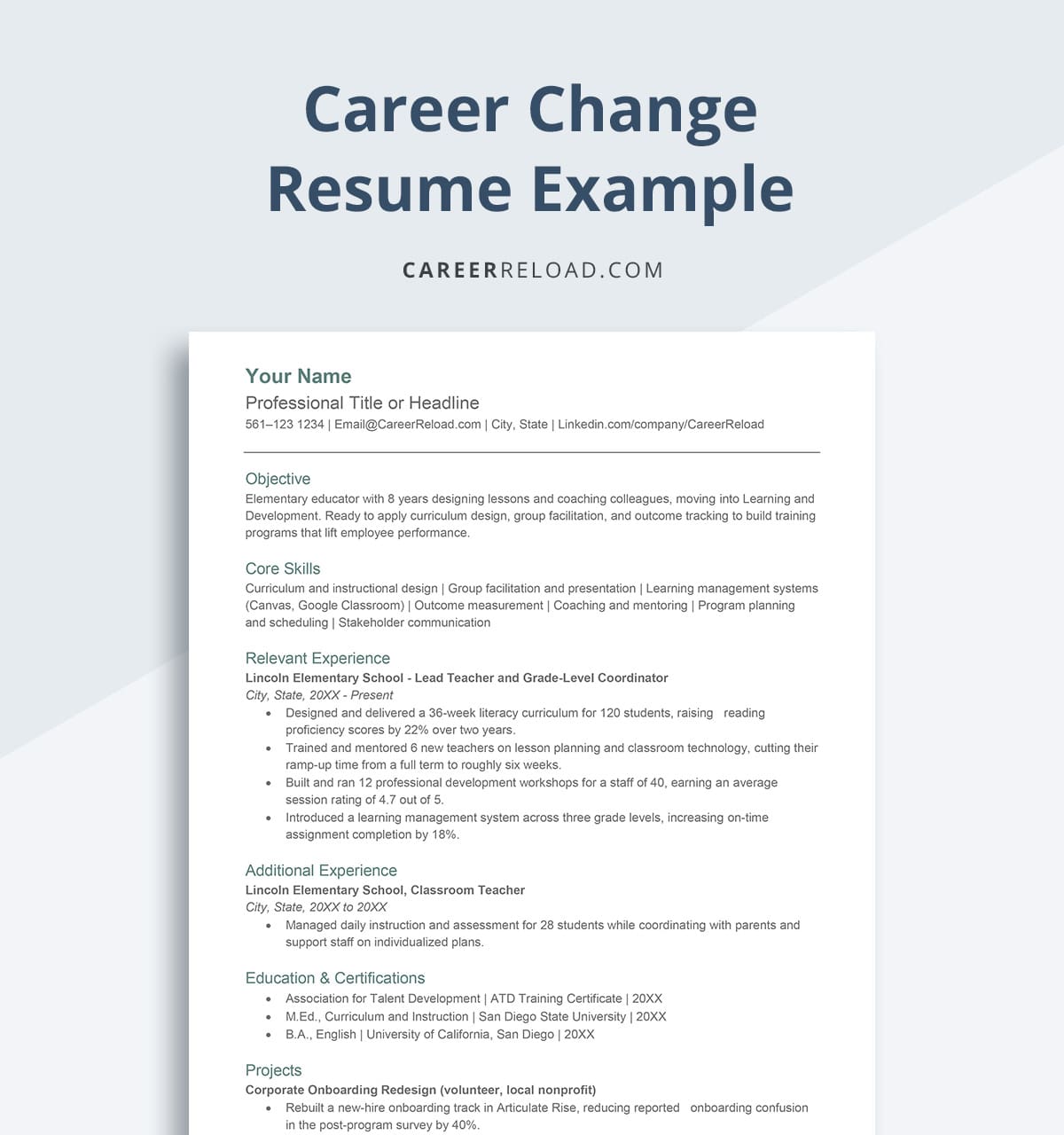
Below is a full example for Maria Delgado, an elementary school teacher moving into a corporate Learning and Development role. It uses a combination format and shows how each section earns its place.
Maria Delgado
Phone Number | Email Address | City, State | LinkedIn
Objective
Elementary educator with 8 years designing lessons and coaching colleagues, moving into Learning and Development. Ready to apply curriculum design, group facilitation, and outcome tracking to build training programs that lift employee performance.
Core Skills
Curriculum and instructional design | Group facilitation and presentation | Learning management systems (Canvas, Google Classroom) | Outcome measurement | Coaching and mentoring | Program planning and scheduling | Stakeholder communication
Relevant Experience
Lincoln Elementary School – Lead Teacher and Grade-Level Coordinator
City, State – 20XX to Present
- Designed and delivered a 36-week literacy curriculum for 120 students, raising reading proficiency scores by 22% over two years.
- Trained and mentored 6 new teachers on lesson planning and classroom technology, cutting their ramp-up time from a full term to roughly six weeks.
- Built and ran 12 professional development workshops for a staff of 40, earning an average session rating of 4.7 out of 5.
- Introduced a learning management system across three grade levels, increasing on-time assignment completion by 18%.
Additional Experience
Lincoln Elementary School, Classroom Teacher
City, State – 20XX to 20XX
- Managed daily instruction and assessment for 28 students while coordinating with parents and support staff on individualized plans.
Education & Certifications
- Association for Talent Development | ATD Training Certificate | 20XX
- M.Ed., Curriculum and Instruction | San Diego State University | 20XX
- B.A., English | University of California, San Diego | 20XX
Projects
Corporate Onboarding Redesign (volunteer, local nonprofit)
- Rebuilt a new-hire onboarding track in Articulate Rise, reducing reported onboarding confusion in the post-program survey by 40%.
Career change resume example for Word
This career change resume example works for a career change because the objective names the target field in the first line, so a recruiter never wonders what Maria wants. The skills section sits above experience and uses Learning and Development language (curriculum design, facilitation, outcome measurement) rather than teaching jargon. Every experience bullet leads with an action verb and ends with a number, which proves impact instead of listing duties. The ATD certificate and the volunteer onboarding project close the credibility gap by showing she has already done the new work, not just the old. Nothing on the page apologizes for the switch.
Free career change resume templates
If you would rather start from a finished layout, here are a few free Word resume templates built for a career change. You can also browse resume templates for Google Docs if you work there instead.
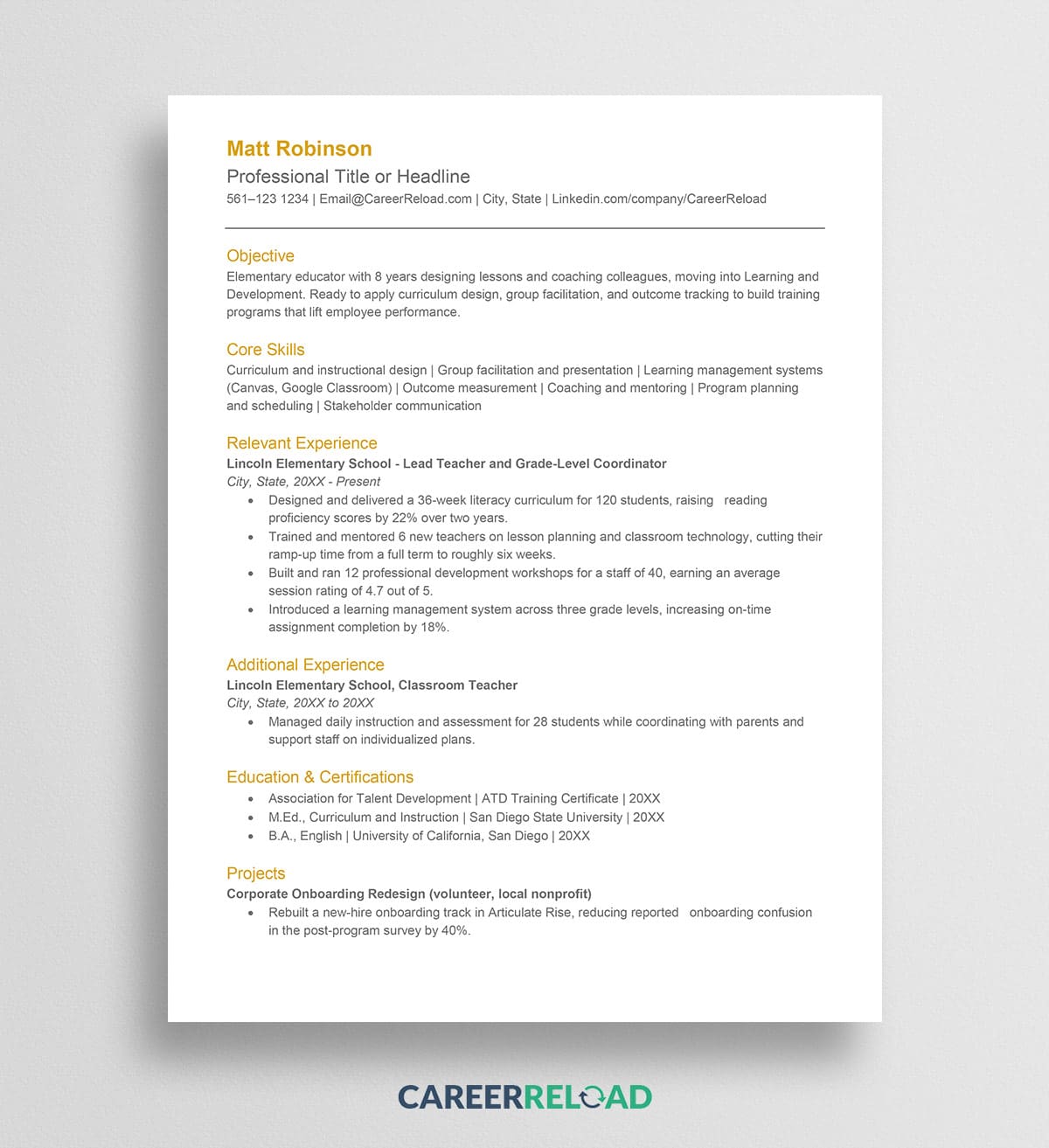
Resume template for a career change, Matt
An option with a brief professional experience section that highlights only your most relevant roles and achievements. Download this template »
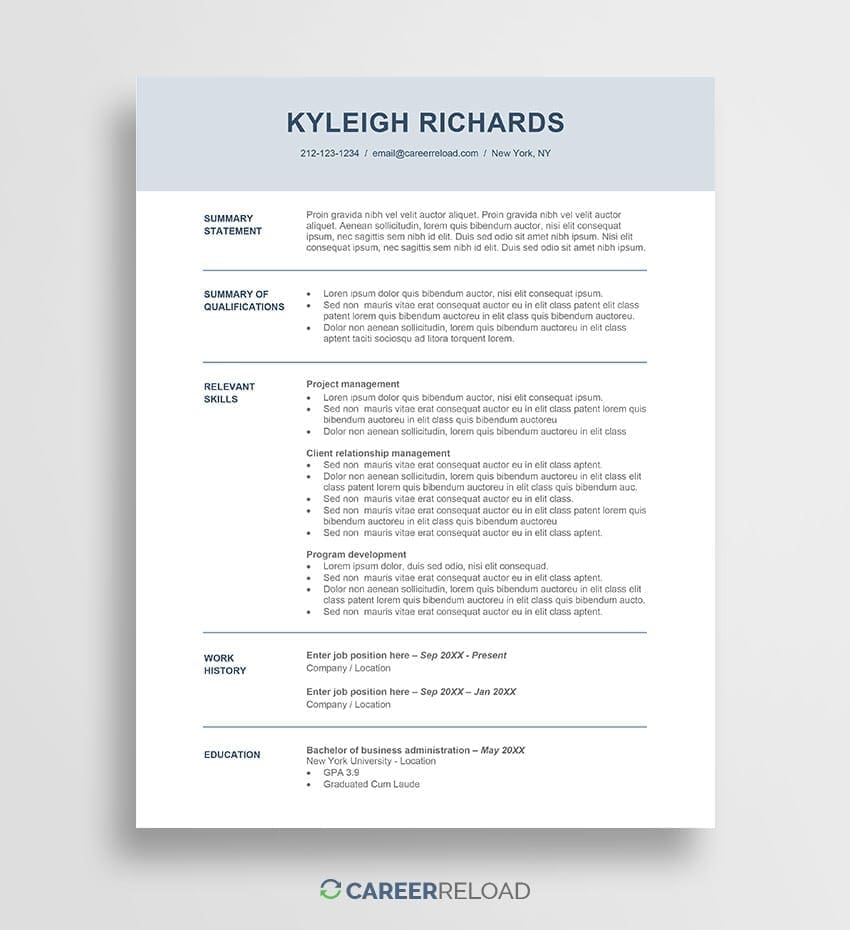
Career change resume template, Kyleigh
A combination layout for a diverse work history. It shows off both skills and experience, which is what most career changers need to balance. Download this template »
Free career change resume, Kendall
This one opens with a career change objective or summary that states your goal, then moves into a skills section focused on transferable strengths. Download this template »

Frequently asked questions
How do you say you are changing careers on a resume?
State it in a short objective or summary at the top of your resume. Name the field you are moving into, lead with the transferable skill that matters most, and point at a result the new employer cares about. You do not need to explain why you are leaving your old field. Let the rest of the resume prove you can do the new job.
What is a good objective for a resume when changing careers?
A good career change objective names the new role, highlights a transferable skill, and shows you understand what the field needs. For example, a marketing professional moving into project management might write that they bring strong organizational skills and experience coordinating multi-team campaigns to keep construction projects on schedule and on budget.
How do you write a resume for a career change with no experience?
Build the resume around transferable skills and proof from outside paid work. Pull skills from your past roles that apply to the new field, then back them with personal projects, volunteer work, internships, or coursework. A finished project that uses the target skill carries real weight even when you have no formal job title in the field yet.
Should I include all my previous work experience on a career change resume?
No. Include the roles and achievements that support your move and trim or shorten the rest. Prioritize experiences that show transferable skills and measurable results tied to the new field. A focused resume reads stronger than a complete one.
Which resume format is best for a career change?
A combination, or hybrid, format suits most career changers because it presents skills before work history. That order lets a recruiter see your relevant strengths before they reach a job title from a different industry. A functional format works when your history is especially scattered or you are returning after a long gap.
Should I mention my career change objective on my resume?
Yes. A clear objective or summary at the top signals your intent immediately and helps a hiring manager connect your background to their opening. Keep it to two or three lines, specific to the role, and focused on what you bring rather than what you are leaving.
Final words
A career change resume succeeds when it does the connecting work for the reader. Pick a combination format, open with an objective that names the move, feature the skills that transfer, and back every claim with a number. Then run your draft against the job posting one more time to confirm the keywords match. Start from one of the career change templates above, drop in your own achievements, and you will have a resume that makes your next field look like the obvious next step.

Sara has been in the career development field for over 10 years and has a wealth of knowledge to share. She covers topics such as resume writing, job search strategies, interview techniques, career planning, and more. She has curated our free downloadable resume templates for Word and resume templates for Google Docs.
Others also read
Financial Analyst Resume Examples to Land Your Dream Job
Phone Interview Tips to Get You to The Next Round
Pharmacist Resume Examples And Writing Tips
How to Highlight Volunteer Experience on Your Resume
AI Tools to Help You With Job Search
Canva Resume Builder Review
College Resume Example That Helps You Standout
16 Niche Job Search Websites for Targeted Job Hunting
You Might Also Like These Free Templates
Resume Template in Word Document
Google Docs Resume Format – Debbie
Free Template for Resume
Free Resume Form Template
2 Column ATS Resume Template
ATS Friendly Resume Format for Word – Lindsay
Cover Letter Template with Monogram
Professional Cover Letter Template
Free Modern Resume Template for Word
Free Job Application Tracker for Excel
Free Resume Template Download for Word – Farrah
Free ATS-Friendly Resume Template – Emily