

It is the ultimate irony of the industry that professionals who spend their days crafting compelling narratives, optimizing conversion funnels, and selling products often struggle to sell themselves. Writing a marketer resume is frequently more difficult for marketing professionals than for candidates in any other field because the pressure is twofold. You are not simply listing your employment history for a recruiter to review. You are demonstrating your competence in real time. The document itself is a portfolio piece.
Your resume must do exactly what a high-converting landing page does. It must hook the reader immediately, communicate value clearly, and drive a specific action. If the user experience of your resume is poor, the recruiter assumes your work product will be poor as well.
A winning marketing resume requires a hybrid approach that few candidates master. It must balance creative storytelling with hard, cold data. Whether you are crafting a digital marketing resume focused on SEO and analytics, or a creative director resume focused on brand vision, the core principles of value demonstration remain the same. You need to prove that you can generate revenue, engagement, and growth, rather than just proving you can complete daily tasks. The modern resume is not a biography. It is a sales pitch.
Marketer resume example (Word version)
This resume is effective because it aligns experience, skills, and outcomes in a way hiring managers can scan quickly and understand value. Overall, it communicates competence, growth, and measurable results without unnecessary detail.
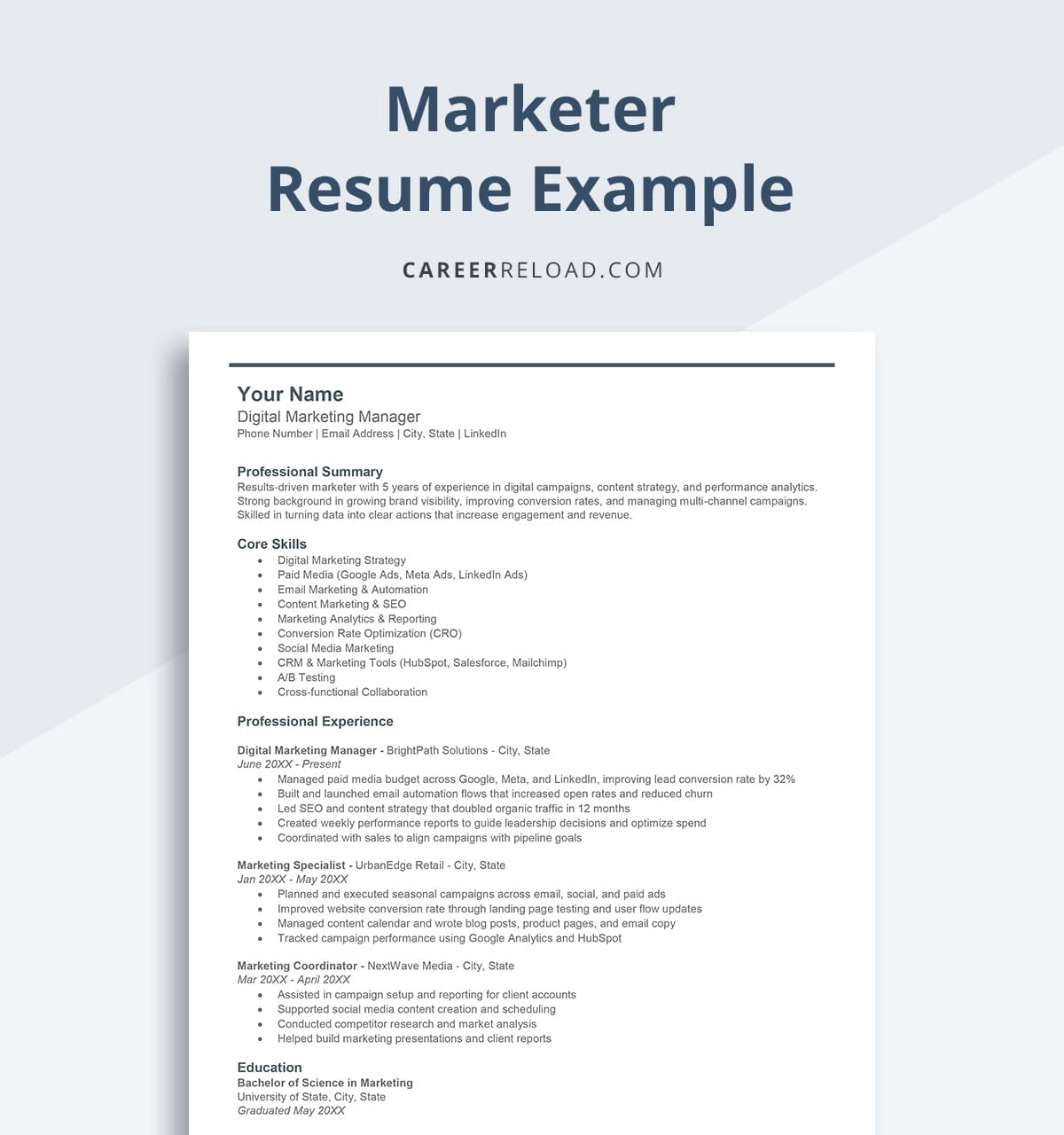
Marketing resume example (Text version)
View more resume samples by industry.
Your Name
Title
Phone Number | Email Address | City, State | LinkedIn
Professional Summary
Results-driven marketer with 5 years of experience in digital campaigns, content strategy, and performance analytics. Strong background in growing brand visibility, improving conversion rates, and managing multi-channel campaigns. Skilled in turning data into clear actions that increase engagement and revenue.
Core Skills
- Digital Marketing Strategy
- Paid Media (Google Ads, Meta Ads, LinkedIn Ads)
- Email Marketing & Automation
- Content Marketing & SEO
- Marketing Analytics & Reporting
- Conversion Rate Optimization (CRO)
- Social Media Marketing
- CRM & Marketing Tools (HubSpot, Salesforce, Mailchimp)
- A/B Testing
- Cross-functional Collaboration
Professional Experience
Digital Marketing Manager – BrightPath Solutions – City, State
June 20XX – Present
- Managed paid media budget across Google, Meta, and LinkedIn, improving lead conversion rate by 32%
- Built and launched email automation flows that increased open rates and reduced churn
- Led SEO and content strategy that doubled organic traffic in 12 months
- Created weekly performance reports to guide leadership decisions and optimize spend
- Coordinated with sales to align campaigns with pipeline goals
Marketing Specialist – UrbanEdge Retail – City, State
Jan 20XX – May 20XX
- Planned and executed seasonal campaigns across email, social, and paid ads
- Improved website conversion rate through landing page testing and user flow updates
- Managed content calendar and wrote blog posts, product pages, and email copy
- Tracked campaign performance using Google Analytics and HubSpot
Marketing Coordinator – NextWave Media – City, State
Mar 20XX – April 20XX
- Assisted in campaign setup and reporting for client accounts
- Supported social media content creation and scheduling
- Conducted competitor research and market analysis
- Helped build marketing presentations and client reports
Education
Bachelor of Science in Marketing
University of State, City, State
Graduated May 20XX
Certifications
- Google Ads Search Certification
- HubSpot Inbound Marketing Certification
- Google Analytics Certification
Tools
Google Analytics, Google Ads, Meta Business Suite, LinkedIn Campaign Manager, HubSpot, Salesforce, Mailchimp, SEMrush, Canva, WordPress, Excel
Achievements
- Recognized as “Top Performer” for exceeding quarterly lead generation targets (20XX)
- Led a campaign that generated the highest email revenue in company history
Preparation: Define your personal value proposition
Before you type a single bullet point or open a word processor, you need to do the heavy lifting of preparation. Many candidates skip this stage and jump straight into formatting, which is a fundamental mistake. To write a standout marketer resume, you must first understand the product you are selling, which means defining your specific lane in the broad marketing landscape.
You must decide if you are presenting yourself as a T-shaped marketer with a broad knowledge base and one deep area of expertise, or if you are a deep specialist, such as an SEO technical lead or a PPC manager. A generic resume that claims to be an expert in everything often ends up appearing like an expert in nothing. Once you have defined your niche, you must gather your evidence. This is arguably the most critical step for modern applications. Go through your past campaigns, analytics dashboards, and monthly reports to find the specific numbers that validate your career.
If you cannot remember the exact conversion rate increase from a campaign you ran three years ago, you need to dig it up now. A marketing resume without numbers is just an opinion, and opinions do not get you hired. You need indisputable facts to back up your claims of competence. Finally, you must analyze your target audience just as you would for a marketing campaign. Treat the hiring manager like a customer persona and tailor your language to their specific pain points.
 Pro Tip: If you are a Copywriter, your resume is your writing test. If you are a Designer, the layout is your design test.
Choose the right format: Design vs. readability
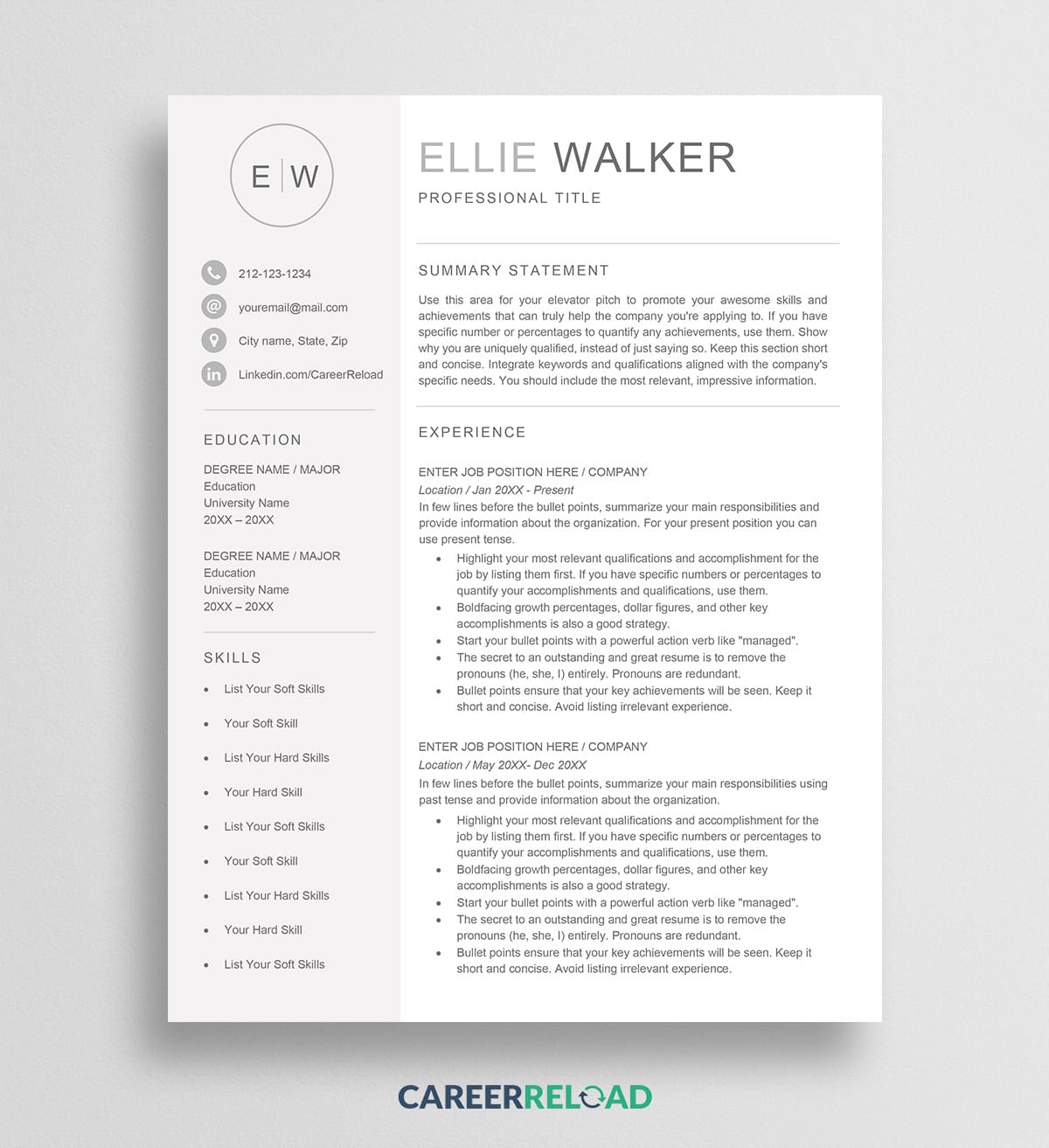
There is a constant debate in the industry regarding how a marketer resume should look, specifically revolving around the balance between design flair and standard readability. It is often tempting to open a design tool and create a resume with multiple columns, icons, skill bars, and a photo. While these look appealing to the human eye, they can be disastrous for your job search. Highly designed resumes often trap valuable keywords in text boxes or graphics that parsing software cannot read, rendering your application invisible before a human ever sees it.
For the vast majority of roles, a clean, modern, text-based layout is superior. Use a single-column format with standard headings to ensure maximum compatibility. If you are a designer, let your portfolio handle the visuals. Your resume is for the data and the narrative. You can still use a nice font and subtle color for your headers to show some personality, but readability must come first. A document that is easy to scan will always outperform a document that is pretty but dense.
There are plenty of Word resume templates and Google Docs resume templates to choose from.


Header and contact info: Optimizing the prime real estate
The top of your page is your billboard, and it needs to convey who you are and how to reach you without wasting valuable space. You should treat this small section as the header of a website. It needs to contain the navigation links required for the user to convert.
Here are the essential elements for a modern header:
- The basics: Include your full name, location (city and state is sufficient), phone number, and a professional email address. Avoid using your current work email, as it looks unprofessional to job hunt on company time.
- Social proof: For a marketing professional, an online presence is non-negotiable. You must include a hyperlink to your LinkedIn profile. If you have an online portfolio, personal website, or a Behance profile, link that as well.
- Title alignment: This is a subtle psychological trick. If your current title is “Marketing Specialist” but you are applying for a “Growth Marketing Manager” role, consider using a headline under your name that says “Growth Marketing Professional” to align your identity with the job.
Professional summary: Your elevator pitch
Gone are the days of the “Objective” statement, as companies already know your objective is to get a job. Instead, you should use a Professional Summary to deliver an elevator pitch that summarizes your value proposition. This section should be a dense, three-to-four line paragraph that hits the reader with your most impressive stats immediately.
A strong formula to follow is to state your years of experience, combine it with your core specialization, and finish with a major achievement that catches the reader’s attention. For example, a strong summary might read: “Performance-driven digital marketer with 7+ years of experience specializing in B2B SaaS lead generation. Expert in managing six-figure monthly ad budgets and implementing automation workflows. Successfully scaled inbound lead volume by 150% at previous agency role.”
This section is also a prime spot for SEO within your document. You should weave in high-level keywords like brand strategy, lead generation, product marketing, or go-to-market execution depending on the role you are targeting. This ensures that both the human reader and the software bot immediately categorize you correctly as a relevant candidate for the position.
Work experience: Turning duties into data
The work experience section is the engine of your resume where you prove you can do the job. The biggest mistake marketers make here is listing responsibilities instead of achievements. You must move beyond passive language and stop using phrases like “Responsible for managing social media,” which are weak and descriptive rather than impressive. Instead, use power words that imply movement and result, such as Orchestrated, Scaled, Generated, Optimized, and Revitalized.
To make this section truly shine, apply the “Google X-Y-Z formula” popularized by Laszlo Bock. This structure forces you to explain the result, the metric, and the methodology all in one line.
Consider the difference between these two approaches:
The passive approach:
“Managed email marketing campaigns for the sales team and wrote weekly newsletters.”
The data-driven approach:
“Generated $50k in incremental revenue (X) by increasing email open rates to 25% (Y) through A/B testing subject lines and segmenting lists (Z).”
The passive approach:
“Helped with the company rebranding project.”
The data-driven approach:
“Led the strategic rebranding initiative (X) which improved brand sentiment scores by 15 points (Y) across all social channels within 3 months (Z).”
You must quantify your impact to create a strong marketing resume. Furthermore, you should contextualize these results. If you increased an open rate by 5%, explain if that is significant for your industry. If you maintained sales during a market downturn, explain that context so the recruiter understands the difficulty of the achievement.
Skills section: Balancing tech with soft skills
Marketing is increasingly technical, and a dedicated skills section helps recruiters quickly see if you have the hard skills required for the role. You should create a specific subsection for your marketing tech stack, as marketers are often hired based on their familiarity with specific platforms. Listing tools like Google Analytics 4, HubSpot, Salesforce, SEMrush, Ahrefs, Figma, or Tableau can be the deciding factor in whether you get an interview.
In addition to tools, you must list your core competencies. These are your high-level functional skills such as Go-to-Market Strategy, Copywriting, A/B Testing, Media Buying, or Community Management. These serve as keywords that help your marketing resume rank in searches and allow recruiters to skim your capabilities quickly. However, you cannot neglect transferable soft skills. While tech is important, soft skills show you can survive and thrive in a corporate environment.
Highlighting skills like cross-functional collaboration, vendor management, and adaptability is crucial. Marketing teams often work closely with sales and product teams, so showing you can collaborate effectively with other departments is a valuable trait that hiring managers look for.
Pro Tip: Don’t just list the tool; describe how you used it. (e.g., ‘Used Marketo to automate lead nurturing flows’).
Education and certifications: Showing continuous learning
In the fast-paced world of marketing, a degree from ten years ago is often less relevant than what you learned yesterday. The landscape changes too fast for traditional education to keep up completely, so while you should list your university, degree, and graduation year, you should keep it brief. If you have been working for more than three years, this section should move to the bottom of the page to make room for more recent experience.
The real value in this section often comes from the certification economy. Certifications carry significant weight in a marketer resume because they prove you are proactive about staying current with industry trends and tools. Listing certifications from recognized authorities validates your skills and shows you are a continuous learner.
High-value credentials to consider listing include:
- Google Ads & Analytics: Specifically the GAIQ or Search/Display certifications.
- HubSpot Academy: Inbound Marketing, Content Marketing, or Email Marketing certifications.
- Meta Blueprint: A strong signal for paid social specialists.
- Salesforce Trailhead: Essential for marketing operations or demand generation roles.
Projects and portfolios: The marketer’s secret weapon
Sometimes your day job does not allow you to show off everything you can do, which is where a Projects section comes in handy. If you are trying to pivot from content writing to social media management, but your job history is all text-based, you can list a side project to bridge that gap. If you grew a TikTok channel to 10k followers or ran Facebook ads for a friend’s bakery, these count as relevant experience and should be included.
Maybe you are a creative, copywriter, or brand strategist, then you must remember that your resume is just the cover letter to your portfolio. You should ensure you explicitly mention where your portfolio can be viewed, or create a section highlighting key campaigns with a direct link to the case studies. This directs the recruiter to the visual proof of your claims.
Furthermore, marketing hiring managers generally love side hustles. Running a personal blog, an e-commerce store, or freelancing shows an entrepreneurial spirit that is highly valued in growth roles. It demonstrates that you live and breathe marketing even off the clock, which suggests you are passionate and self-motivated.
Optimizing for keywords and ATS
To get your resume into human hands, you often have to get past the gatekeeper algorithm first. This requires a strategy of mirroring the job description. Open the job description of the role you want and highlight the specific nouns and phrases they use. If they ask for “demand generation” and your resume says “lead gen,” change it to match their terminology. If they ask for “B2B SaaS” experience, ensure those exact words appear in your summary or skills section.
You must also consider the frequency and placement of these keywords. Do not stuff keywords into a white-text block at the bottom of the page, as algorithms are smarter than that now and may penalize you. Instead, place your primary keywords in your summary, your skills section, and naturally within your work experience bullet points. This helps the software understand the context of your skills.
Finally, unless the application portal specifically demands a Word document, always upload your resume as a PDF. This ensures that your formatting stays intact regardless of what computer the recruiter is using, preventing your carefully crafted layout from breaking. However, keep the PDF text-selectable so the bots can read it easily.
Common mistakes to avoid in a marketing resume
Even experienced pros make avoidable errors that cost them interviews. By avoiding these specific pitfalls, you place yourself ahead of half the candidate pool immediately.
- Buzzword bingo: Avoid calling yourself a “Mastermind,” “Ninja,” “Rockstar,” or “Wizard.” These terms are outdated and can come across as immature or arrogant. Stick to professional titles like “Specialist,” “Strategist,” or “Manager” to maintain credibility.
- Broken links: Nothing kills a digital marketer resume faster than clicking a link to a portfolio or LinkedIn profile and seeing a 404 error. It implies a lack of attention to detail, which is a critical skill for the job. You must check every hyperlink on your PDF before sending it out.
- Inconsistency: Your resume and your LinkedIn profile must tell the same story. If your resume says you were a Manager but LinkedIn says Associate, it raises red flags about your honesty and attention to detail. Ensure dates and titles align perfectly across all platforms.
Conclusion: Checklist and final polish
Writing a marketer resume is an exercise in personal branding that requires you to step back and view your career through the lens of a hiring manager. Before you hit send, you need to do a final gut check to see if the document makes you look like an investment that will bring a return. Typos in a resume for a detail-oriented job are fatal, so read your resume backward, starting from the last sentence, to catch spelling errors that your brain might skip over. Use tools like Grammarly, but do not rely on them entirely.
You now have the roadmap to build a document that stands out in a crowded market. Do not wait until you see the perfect job opening to start this process. Begin gathering your data and drafting your bullet points today so you are ready when the opportunity arises. A great marketing resume is a living document that grows as your career scales, constantly evolving to reflect your latest wins.

We’re a team of writers and career experts who share practical insights to help you navigate the professional world. Our members include Certified Professional Résumé Writers (CPRW) and Certified Digital Career Strategists (CDCS), and we bring experience from many industries to help you build your career with confidence. Download free Word resume templates and resume templates for Google Docs.
Others also read
What Every Job Seeker Should Know About Employer Identification Numbers
Scrum Master Resume Examples and Writing Guide
How To Write A Career Change Resume
How to Use the STAR Method to Ace Your Job Interview
Peer Interviews: A Smart Way to Build Stronger Teams
Data Entry Resume Example and Writing Guide
Building Trust with Employers: The Power of a Domain Email Address
How to Reach Out to Hiring Managers (And What to Say)
You Might Also Like These Free Templates
Google Docs Resume Format – Debbie
Free Resume Form Template
Free Resume Design – Megan
2 Column ATS Resume Template
ATS Friendly Resume Format for Word – Lindsay
Goal Planner Template
Cover Letter Template with Monogram
Professional Cover Letter Template
Free Modern Resume Template for Word
Free Job Application Tracker for Excel
Free Resume Template Download for Word – Farrah
Free ATS-Friendly Resume Template – Emily