

When you first look at your resume, it may feel like a list of duties and job titles rather than a story. Yet every line you’ve written hides a story of what you faced, how you acted, and what changed. That’s where the SOAR method resume approach comes in. It turns dry bullet points into vivid moments that show your strengths, decisions, and impact.
This article will guide you through turning routine resume lines into memorable SOAR resume examples that make you shine on paper and in interviews.
Also read:
- Improve Your Resume With The 5 P’s of Resume Writing
- How to Use the XYZ Formula for Writing Resumes
- How to Create a CAR Method Resume
Why use the SOAR method resume
The SOAR method stands for Situation, Obstacle, Action, and Results. It invites you to frame your achievements not as tasks, but as moments where you spotted a problem, acted on it, and created meaningful outcomes. That’s more compelling than simply listing what you did.
Compared to the older STAR method resume, SOAR brings “Obstacle” front and center, helping you highlight challenge and insight not just your assignment. That makes your stories richer and more distinctive. Research shows hiring managers value problem‑solving and adaptability above just technical tasks.
Finding your SOAR story behind each job entry
Start by picking key moments in your career, times when things went wrong or hit a snag. Perhaps you lost a client, faced tight deadlines, or tackled an unexpected crisis. Those are fertile ground for SOAR resume examples.
Think of each role as a story with four parts:
- Situation: set the scene: where were you, what was happening?
- Obstacle: pinpoint the problem or barrier you encountered.
- Action: show how you responded, what you thought, who you involved, choices you made.
- Results: share the measurable outcome and what you learned.
Over time, you’ll collect several of these stories. Then distill each one into a resume bullet that leads with a strong verb, mentions the challenge, describes your response, and finishes with numbers or effects.
Crafting a SOAR resume bullet
Imagine you once led a small team that struggled to meet deadlines.
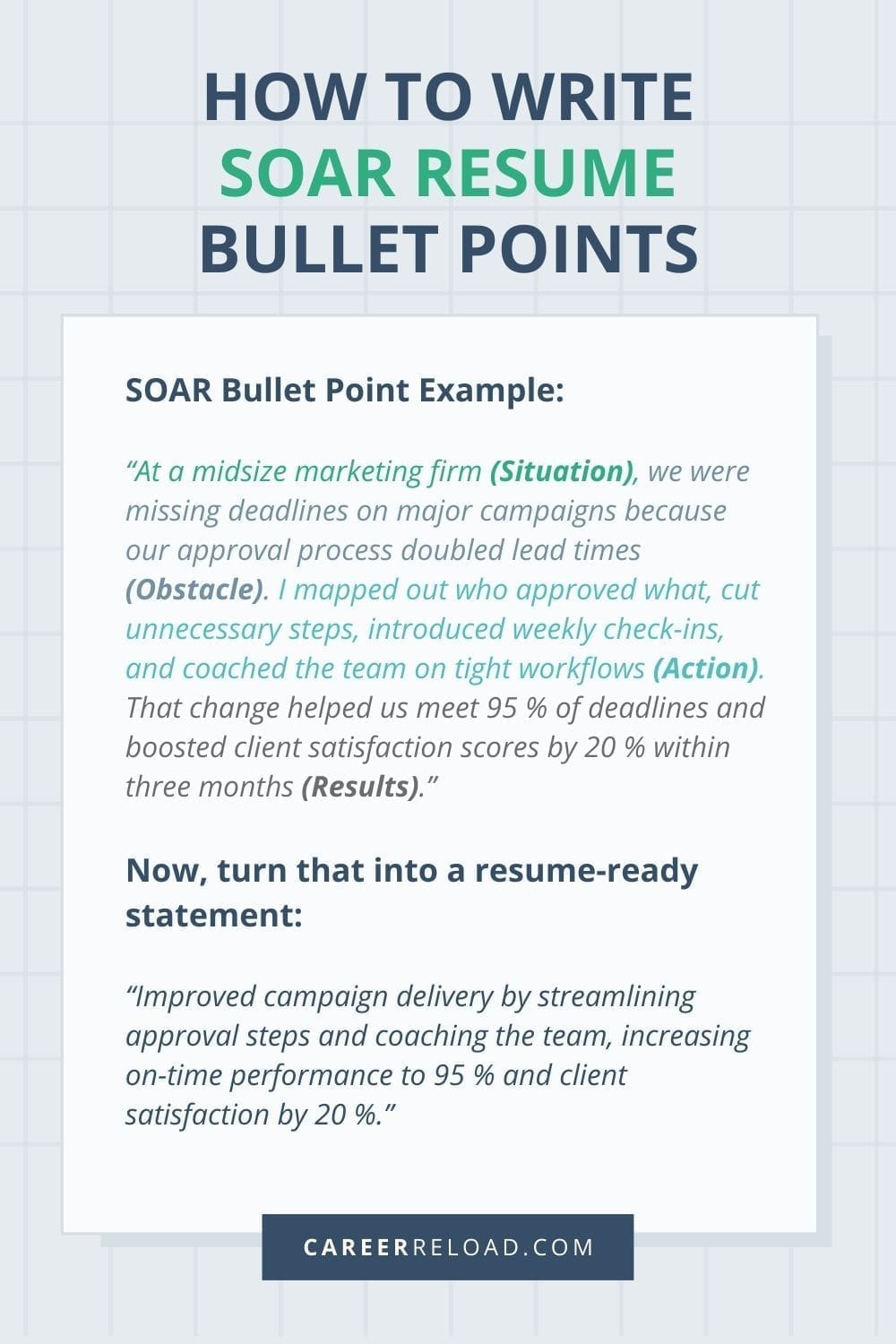
Here’s a SOAR resume example:
“At a midsize marketing firm (Situation), we were missing deadlines on major campaigns because our approval process doubled lead times (Obstacle). I mapped out who approved what, cut unnecessary steps, introduced weekly check-ins, and coached the team on tight workflows (Action). That change helped us meet 95 % of deadlines and boosted client satisfaction scores by 20 % within three months (Results).”
Now, turn that into a resume-ready statement:
“Improved campaign delivery by streamlining approval steps and coaching the team, increasing on-time performance to 95 % and client satisfaction by 20 %.”
That is a clear, action-driven SOAR resume example. It shows what you did, why it mattered, and what changed.
Weaving your SOAR stories together into a narrative
Your resume’s experience section becomes more than a work history when you use the SOAR method. Each entry tells a mini-story that flows into the next. You’re showing how you didn’t just do your job, you improved it, fixed issues, adapted under pressure.
As you write, keep paragraphs where needed to explain larger projects. For example, if you:
- Managed a rollout of new software under tight budget (Situation and Obstacle),
- Dialogued with vendors, identified cost-saving alternatives, and trained staff (Action),
- Delivered under budget, improved team efficiency, and reduced support tickets (Results),
You can write two to three narrative sentences and then embed one strong SOAR resume bullet to draw it together.
Putting it all together: step-by-step
Think of your process like this:
- Look at each job you’ve held and pick 3–5 moments where you faced problems or made things better.
- Write them out in full SOAR format, like short narratives.
- From each, create a strong, concise bullet.
- Place those bullets strategically in your resume under each relevant position. Use one narrative sentence to tie them together if needed.
- Review your whole resume. Does it flow as a story of growth? Do keywords appear naturally?
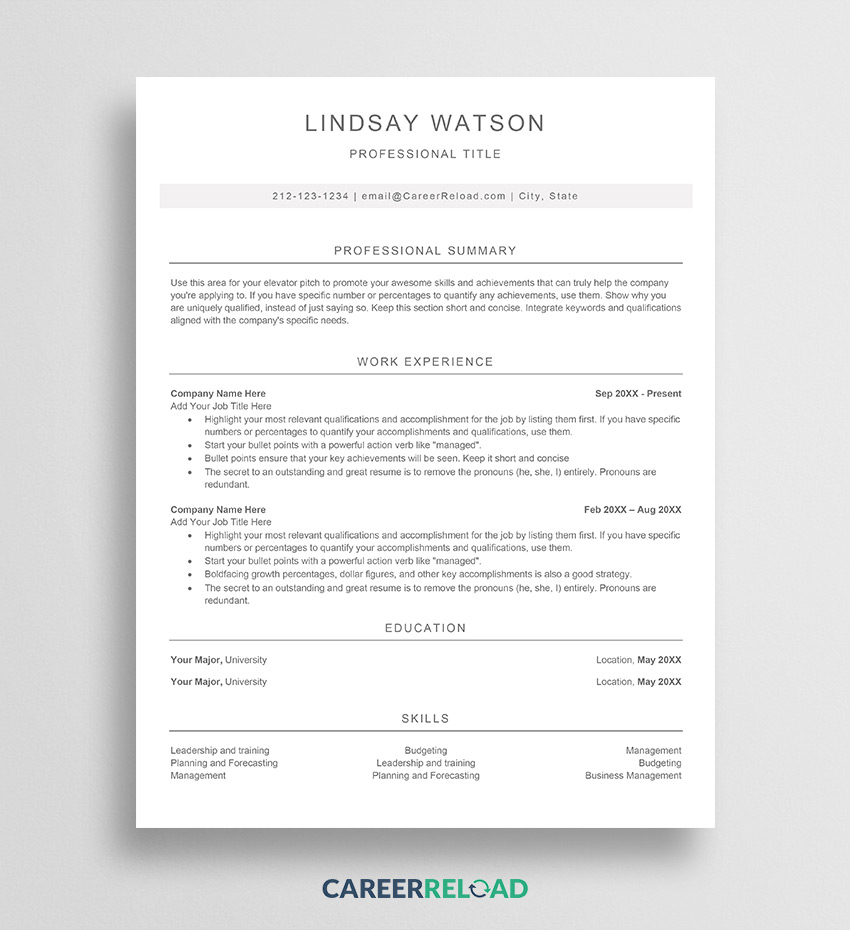
Finalize it all with professional resume templates for Word or Google Docs resumes:


Final thoughts
Turning your resume into a SOAR resume can make the difference between blending in and standing out. Instead of just stating responsibilities, you show how you respond to challenges, act with insight, and make an impact.
Read through your resume one more time and ask yourself: does each point show a problem and a solution? If not, it’s a sign to apply the SOAR method resume technique to that part. Soon, your resume will do more than list jobs, it will tell a vivid story of your achievements.
Once you’ve applied this approach, your resume doesn’t just talk, it resonates. That is the power of SOAR in a resume.

Sara has been in the career development field for over 10 years and has a wealth of knowledge to share. She covers topics such as resume writing, job search strategies, interview techniques, career planning, and more. She has curated our free downloadable resume templates for Word and resume templates for Google Docs.
Others also read
Scrum Master Resume Examples and Writing Guide
How to Create a Resume in Word (Step-by-Step Guide)
Accountant Resume Examples That Work
How Personality Tests Can Help You in Your Career and Job Search
How to Spot and Avoid a Fake Job Posting
Resignation vs. Quitting: Professional vs. Unprofessional Exit
How to Land a Job Through Networking
16 Niche Job Search Websites for Targeted Job Hunting
You Might Also Like These Free Templates
Google Docs Resume Format – Debbie
Free Resume Form Template
Free Resume Design – Megan
2 Column ATS Resume Template
ATS Friendly Resume Format for Word – Lindsay
Goal Planner Template
Cover Letter Template with Monogram
Professional Cover Letter Template
Free Modern Resume Template for Word
Free Job Application Tracker for Excel
Free Resume Template Download for Word – Farrah
Free ATS-Friendly Resume Template – Emily