
The modern workforce undergoes constant evolution. While society once pushed every student toward a four year university degree, the professional landscape now reveals a different reality. High demand for specialized manual and technical expertise creates a golden opportunity for many. Choosing a career in the skilled trades offers a path toward financial stability, personal fulfillment, and long term security.
Many people find themselves stuck in office environments that lack physical engagement or tangible results. Conversely, trade professionals build the infrastructure of our world. They keep our lights on, our water flowing, and our homes comfortable. This article explores why you should consider a career in the skilled trades and how this choice can transform your professional future.
1. Exceptional Job Security and Growing Demand
The global economy relies on the physical infrastructure that trade professionals maintain. Unlike many digital roles that companies can outsource or automate, skilled labor requires a physical presence and human problem solving. You cannot outsource a plumbing emergency or automate the complex electrical wiring of a new hospital.
Experts often refer to the current labor market as the Great Retirement. A significant portion of the current workforce consists of baby boomers who approach retirement age. As these experienced professionals exit the industry, they leave behind a massive vacancy. This gap creates an unprecedented level of job security for newcomers.
Industry data suggests that for every five tradespeople who retire, only one new professional enters the field. This disparity ensures that anyone who chooses a career in the skilled trades enters a market where employers compete for their talents. The following points highlight the stability of these roles:
- Essential services remain recession proof because people always need heat, electricity, and structural repairs.
- Government infrastructure projects require thousands of specialized workers for decades to come.
- Urbanization and population growth drive the constant need for new residential and commercial construction.
- The rise of green energy creates new niches for wind turbine technicians and solar panel installers.
When you possess a specialized skill set, you gain leverage. You no longer worry about sudden layoffs or industry obsolescence. Instead, you build a career on a foundation of necessity.
2. Financial Freedom and High Earning Potential
A common misconception suggests that trade jobs offer lower pay than white collar roles. In reality, the financial benefits of a career in the skilled trades often surpass those of traditional office jobs, especially when you consider the cost of entry.
University students frequently graduate with massive debt. Some carry six figure loans that take decades to repay. Trade professionals typically take a different path. Many vocational schools offer programs that cost a fraction of a university tuition. Furthermore, many individuals enter the field through apprenticeships.
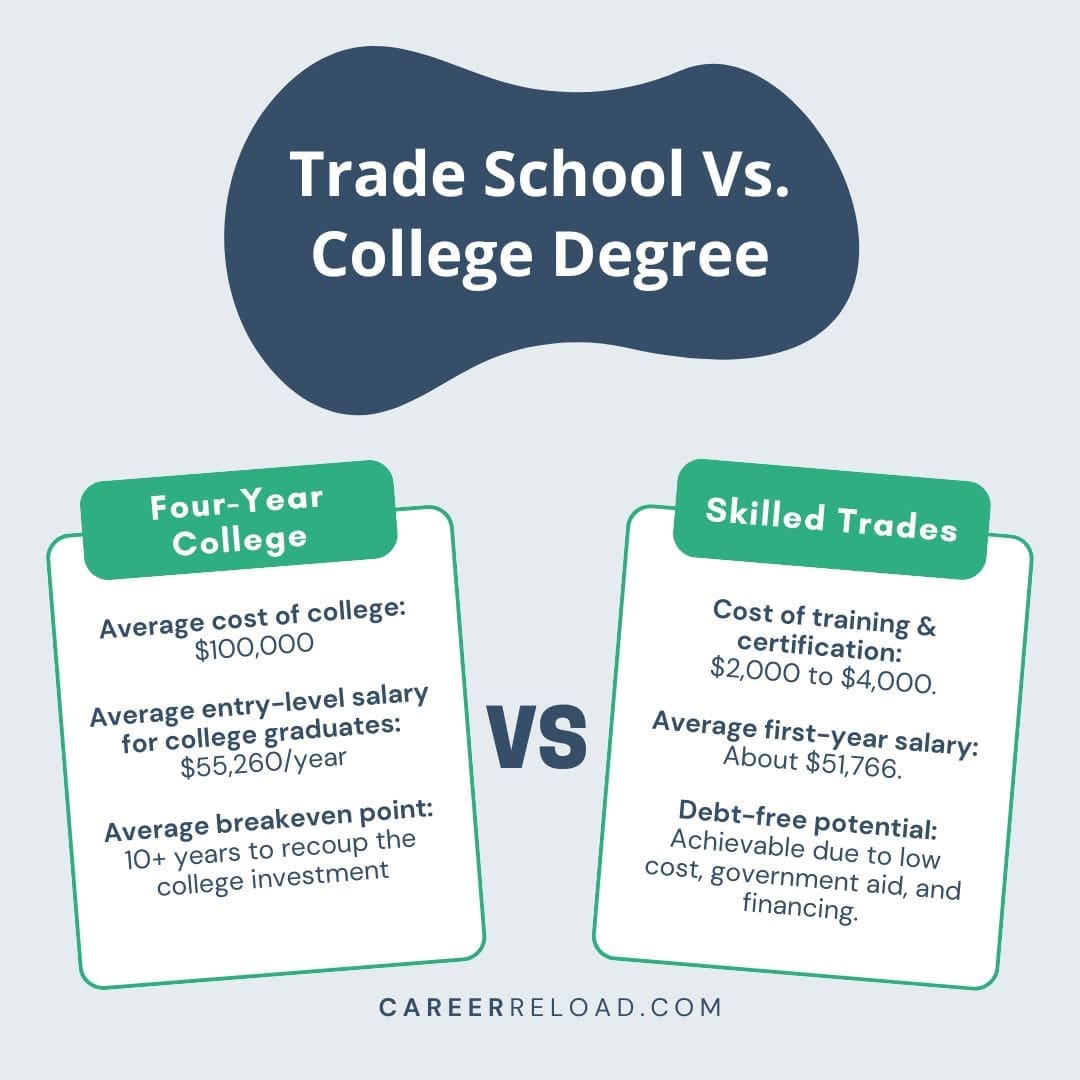
In an apprenticeship, you earn while you learn. Employers pay you a wage to assist journey level workers while you gain your certification. This means you enter the workforce with zero debt and several years of earnings already in your bank account.
Consider the following financial advantages:
- Experienced electricians, plumbers, and elevator mechanics often earn salaries that exceed the national average for college graduates.
- Overtime opportunities allow workers to increase their take home pay significantly.
- Many trade roles come with robust benefit packages, including healthcare and pensions.
- Specialized certifications in high tech areas of the trades command premium hourly rates.
The return on investment for a career in the skilled trades remains one of the highest in the modern economy. You spend less time in a classroom and more time building wealth.
3. Faster Entry into the Professional Workforce
Time is a precious commodity. A traditional bachelor’s degree requires at least four years of full time study. Many students take even longer to finish. During those years, students lose out on potential income and professional experience.
If you choose a career in the skilled trades, you can often complete your training in six months to two years. Some programs focus on intensive, hands on learning that prepares you for the field immediately. This efficiency allows you to start your life sooner. You can buy a home, start a family, or invest in your future while your peers still attend lectures.
The streamlined nature of trade education offers several benefits:
- Curriculums focus strictly on the skills you need for the job.
- Hands on training replaces abstract theory, which benefits practical learners.
- Frequent start dates at vocational schools allow you to begin your education at any time of the year.
- The transition from student to professional happens seamlessly through industry connections and placement programs.
By entering the workforce early, you gain a head start on retirement savings. The power of compounding interest works in your favor when you begin investing your earnings in your early twenties.
4. Tangible Results and High Job Satisfaction
Many office workers struggle with a sense of purposelessness. They spend their days moving data between spreadsheets or attending endless meetings. This lack of physical output often leads to burnout and dissatisfaction.
A career in the skilled trades provides immediate, visible results. At the end of a workday, a carpenter can look at a framed house. An HVAC technician can see a climate control system functioning perfectly. A welder can inspect a flawless seam that holds a bridge together.
Psychologists often link happiness to the concept of flow and the ability to see the fruit of one’s labor. Trade work requires a blend of mental acuity and physical dexterity. You must solve complex puzzles and then execute the solution with your hands.
Common sources of satisfaction in the trades include:
- The pride of building something that lasts for generations.
- The gratitude of homeowners when you restore their essential services.
- The variety of work environments, which prevents the boredom of sitting in the same cubicle every day.
- The camaraderie found in crew environments where everyone works toward a common goal.
When you contribute something real to the world, your work gains meaning. This sense of accomplishment fuels long term career satisfaction.
5. Opportunities for Entrepreneurship and Growth
The skilled trades offer a clear ladder for advancement. You do not have to work for someone else forever. In fact, the trades provide one of the most accessible paths to business ownership in the world.
Once you achieve master status in your craft, you can start your own company. Many successful entrepreneurs began as apprentices. They learned the technical side of the business first and then transitioned into management and ownership.
As a business owner in the trades, you control your schedule, your client base, and your income. You can scale your business by hiring other technicians or keep it small and specialized. The demand for reliable contractors remains so high that a good reputation practically guarantees work.
Growth opportunities in a career in the skilled trades include:
- Moving into supervisory roles like project manager or site foreman.
- Specializing in high tech niches like smart home automation or industrial robotics.
- Transitioning into consulting or building inspection.
- Teaching the next generation of tradespeople at vocational colleges.
The ceiling for your success depends entirely on your ambition. You are not limited by corporate ladders or office politics. Your skills belong to you, and you can take them anywhere.
The Role of Technology in Modern Trades
Some people mistakenly view the trades as low tech. This could not be further from the truth. Modern trade professionals use sophisticated technology every day. Plumbers use thermal imaging and fiber optic cameras to locate leaks. Electricians work with complex renewable energy systems and automated grids.
If you enjoy working with technology but dislike the idea of sitting at a desk, a career in the skilled trades offers the perfect compromise. You get to use cutting edge tools and software to solve real world problems. The integration of 3D printing, drones for site inspections, and Building Information Modeling (BIM) software has revolutionized the industry.
Staying updated on these technologies ensures that your expertise remains relevant. This technical layer adds another level of intellectual stimulation to the work. You never stop learning because the tools and methods constantly improve.
Breaking Stereotypes: A Career for Everyone
The trades are becoming more inclusive every day. More women and individuals from diverse backgrounds now enter these fields. Organizations specifically dedicated to supporting women in the trades provide mentorship and resources to help newcomers thrive.
Modern equipment and ergonomic tools reduce the physical strain that once characterized these roles. This makes the trades accessible to a wider range of people regardless of their physical stature. If you have an analytical mind and a drive to succeed, you belong in this industry.
Choosing a career in the skilled trades means joining a community of professionals who value hard work and competence above all else. It is a meritocracy where your skills determine your value.
How to Start Your Journey
If these reasons resonate with you, the path forward is clear. Research the various trades to find one that aligns with your interests. Do you enjoy the logic of electrical circuits? Do you prefer the precision of machining? Perhaps you love the artistic side of masonry or woodworking.
Once you identify an interest, take the following steps:
- Visit local vocational schools or community colleges to see their lab facilities.
- Contact local unions or trade associations to ask about apprenticeship opportunities.
- Speak with professionals currently working in the field to get a realistic view of their daily lives.
- Look for “pre-apprenticeship” programs that provide a basic introduction to multiple trades.
The barrier to entry is low, but the potential for reward is high. You do not need a perfect academic record to succeed. You need a willingness to learn and a commitment to quality.
Conclusion
The decision to pursue a career in the skilled trades represents a strategic move toward a stable and prosperous future. You bypass the debt trap of traditional education while entering a field that desperately needs your skills. You gain the freedom to work with your hands, solve interesting problems, and see the physical impact of your efforts.
The world cannot function without the expertise of tradespeople. By choosing this path, you become an essential part of the global economy. You build a life based on tangible skills that no machine can replace. Whether you aim for business ownership or a steady role in a respected company, the trades provide the tools you need to build a legacy.
Stop waiting for a traditional path to offer you fulfillment. Take control of your professional destiny. Explore a career in the skilled trades today and discover a world of opportunity that exists right at your fingertips. The infrastructure of tomorrow requires your hands, your mind, and your dedication. This choice does not just provide a paycheck; it provides a sense of pride and a clear path to the American dream.

Sara has been in the career development field for over 10 years and has a wealth of knowledge to share. She covers topics such as resume writing, job search strategies, interview techniques, career planning, and more. She has curated our free downloadable resume templates for Word and resume templates for Google Docs.
Others also read
How to Write a Resume for Internal Position
How to Achieve the Perfect Resume Design
How to use ChatGPT as an Interview Coach and Practice Partner
Office Manager Resume Examples and Writing Guide
How to Use Storytelling Resume Format to Make Your Student Resume Memorable
How to Write an Executive Resume
How to Write an Impressive Medical Resume
Reference Letter vs. Recommendation Letter
You Might Also Like These Free Templates
Resume Template in Word Document
Google Docs Resume Format – Debbie
Free Template for Resume
Free Resume Form Template
2 Column ATS Resume Template
ATS Friendly Resume Format for Word – Lindsay
Cover Letter Template with Monogram
Professional Cover Letter Template
Free Modern Resume Template for Word
Free Job Application Tracker for Excel
Free Resume Template Download for Word – Farrah
Free ATS-Friendly Resume Template – Emily