

A scholarship resume is a one-page document that summarizes your academic record, activities, awards, and work or service experience for a selection committee deciding who gets funded. It differs from a job resume in one critical way: school and impact go first, paid work goes second. To write one, list your contact details, write a 2 to 4 sentence objective tied to the specific scholarship, lay out academics with GPA and relevant coursework, follow with activities and work experience using quantified bullet points, and close with awards, honors, and skills.
Most students treat a scholarship resume like a job resume in a cap and gown. That is why so many of them lose. A committee reading a hundred applications in an afternoon does not need to know you were a “team player” at the smoothie shop. They need to see, in 30 seconds, whether you fit the criteria the donor wrote into the scholarship terms.
This guide walks through the format, the section-by-section content, four annotated examples for different student profiles, a fillable resume template, the mistakes that quietly sink applications, and the answers to the questions students keep asking.
What is a scholarship resume and how is it different from a job resume?
A scholarship resume is the supporting document committees use to verify the claims you make in your essay and application form. It exists so a reviewer can see your record on one page without hunting through transcripts.
The structural difference from a job resume comes down to ordering and emphasis.
| Feature | Job resume | Scholarship resume |
| Opening statement type | Professional summary | Objective tied to the scholarship |
| Most important section | Work experience | Education and academic record |
| GPA | Usually omitted after first job | Always included if 3.0 or above |
| Relevant coursework | Rarely listed | Listed when it supports your goal |
| Volunteer work | Optional, often last | Often weighted equal to paid work |
| Length | 1 to 2 pages | One page, no exceptions |
| Photo or personal info | Removed in most countries | Removed (age, religion, marital status) |
A second difference is the audience. A hiring manager wants to know whether you can do a specific job. A scholarship committee wants to know whether you match a profile the donor cares about, whether the donor cares about academic merit, financial need, a specific field of study, community service, leadership, or a heritage tie. The resume is your evidence file for that match.
Scholarship resume format
The format is fixed and worth getting right because committees use it as a quick filter. Resumes that do not follow it look unserious before a reviewer reads a single word.
- Length. One page. If you cannot fit on one page, cut older or weaker entries until you can.
- Margins. 0.7 to 1 inch on all sides. Anything narrower looks crowded.
- Font. A clean serif or sans-serif at 10 to 12 point for body text and 12 to 14 for section headings. Calibri, Arial, Garamond, and Times New Roman are all safe.
- File type. PDF unless the application portal asks for .docx. PDF locks the layout.
- File name. LastName_FirstName_ScholarshipResume.pdf. Generic names like resume_final_v2.pdf get lost in committee inboxes.
- Order of sections. Contact info, objective, education, activities and leadership, work and volunteer experience, awards and honors, skills. Adjust order based on your strongest material; if you have published research, that section moves up.
- Reverse chronological. Newest entries first inside every section.
How to write a scholarship resume in 7 steps
1. Read the scholarship terms before you write a word
Every scholarship has selection criteria written somewhere in the application materials, on the funder’s site, or in the founding bequest. Find them. A merit scholarship rewards academic results. A leadership scholarship rewards initiative and impact. A heritage scholarship rewards community involvement tied to a specific group. The criteria tell you which of your experiences belong on the page and which to leave off.
This single step is what separates the applicants who get funded from the ones who do not. Tailoring is not optional, it is the job.
2. List your contact information
Put this block at the top, no heading needed.
- Full name (first and last, the way it appears on official records)
- City and state or country (a full street address is no longer expected and creates a privacy risk)
- Phone number
- Email address (use a clean one, firstname.lastname@gmail.com beats partygurl2007@hotmail.com)
- LinkedIn URL if you have one with a professional photo and a complete profile
- A portfolio, GitHub, or research page when relevant to the field
Skip your photo, birthdate, marital status, religion, gender, and nationality unless the scholarship explicitly asks for them. In the United States these categories are protected, and including them can complicate the committee’s review.
3. Write a tailored objective in 2 to 4 sentences
The objective sits directly under your contact info. It tells the committee, in plain language, who you are, what you have done, what you want to do, and why this scholarship fits.
A useful structure:
- One sentence on your current academic status and a top achievement
- One sentence on the field, project, or cause you want to pursue
- One sentence naming the scholarship and tying your goals to its mission
Rewrite the objective for every scholarship. The body of the resume can stay the same. The objective cannot.
4. Detail your academic experience
Education is the most important section on a scholarship resume. List every school relevant to your current level.
For each entry, include:
- Institution name and city
- Degree or program (or “High School Diploma” with a graduation year)
- Graduation date or expected graduation date
- GPA if it is 3.0 or higher (use the school’s scale, e.g. 3.8/4.0)
- Class rank if you know it and it helps (e.g. top 5%)
- Standardized test scores if strong and recent (SAT, ACT, GRE, IB, A-levels)
- Relevant coursework, 3 to 6 courses that match the scholarship’s field
- Honors programs or honor society memberships
If you have study abroad, a senior thesis, or a research project, give it its own subsection here. These are the items committees underline.
5. Show activities, leadership, and service with numbers
This is where most resumes go flat. Students list “Volunteered at the food bank” and stop. The committee learns nothing.
Every activity entry needs three things: what you did, what you led or built, and a number that proves the scale. Numbers can be people served, dollars raised, hours given, posts published, members in a club you ran, percentage growth in something you tracked, or anything else you can count.
Compare these:
- Volunteered at local food bank
- Volunteered 240 hours at Second Harvest Food Bank, sorted 4 tons of donations, and trained 12 new volunteers as shift lead
The second version is the same activity. It just respects the reader.
6. Add work experience, even if it is part-time
Work experience belongs on a scholarship resume even when it is unrelated to your field. Committees want to see you can hold responsibility. A grocery store cashier who worked 20 hours a week for two years while keeping a 3.7 GPA is making an argument the resume should make for them.
Treat each role like a story in three lines:
- What you were responsible for
- One concrete improvement, fix, or project you ran
- A number wherever possible (sales, customers served, hours, retention)
Internships, research assistantships, paid tutoring, and freelance work all count.
7. Close with awards, honors, and skills
The bottom of the page is for things that take one line each. Group them so the page does not turn into a wall of text.
- Awards and honors: scholarships you have already won, dean’s list semesters, academic competition placements, named departmental awards
- Publications and presentations: any piece in a school paper, journal, or conference
- Skills: language proficiency with level (e.g. Spanish, B2 CEFR), software you actually use (Python, R, SPSS, Adobe Creative Suite), lab techniques, certifications
- Memberships: honor societies, professional associations, debate or model UN
Skip “Microsoft Word” and “good communication skills.” Both are assumed.
Scholarship resume examples for different student profiles
Each example below is followed by notes on what the resume is doing well and why it works for that specific committee.
Example 1: High school senior applying for a merit scholarship
MAYA OKONKWO
Phone Number | Email Address | City, State | LinkedIn
OBJECTIVE
Salutatorian and three-time state Science Olympiad medalist applying for the National Merit Scholarship to study chemical engineering at Georgia Tech. Aiming to research polymer-based water filtration through the school’s Vertically Integrated Projects program.
EDUCATION
Westlake High School, Atlanta, GA
Graduating June 20XX
- GPA: 4.42 weighted, 3.98 unweighted | Class rank: 2 of 412
- SAT: 1540 (770 Math, 770 EBRW)
- AP Coursework: Chemistry (5), Calculus BC (5), Physics C: Mechanics (5), English Literature (4), United States History (5)
ACTIVITIES & LEADERSHIP
Captain, Westlake Science Olympiad Team, 20XX – Present
- Led 15-member team to first state-level win in school history
- Personally medaled in Chemistry Lab (gold), Forensics (silver), and Detector Building (bronze) at Georgia state finals
- Organized weekly 2-hour practice sessions and built the team’s internal training wiki used by underclassmen
Founder, Westlake STEM Tutoring Network, 20XX – Present
- Recruited 22 student tutors to give free chemistry and math help to 9th and 10th graders
- Tutored 90+ students over two academic years
- Partnered with three teachers who refer struggling students each semester
WORK EXPERIENCE
Lab Assistant, Georgia Tech Polymer Outreach Program, Summer 20XX
- Cleaned and prepared lab equipment for graduate-led demonstrations shown to 200 visiting middle-school students
- Co-wrote one experiment guide now used in the program’s curriculum
AWARDS & HONORS
- National Merit Semifinalist (20XX)
- Coca-Cola Scholars Regional Finalist (20XX)
- AP Scholar with Distinction (20XX)
- Westlake High School Excellence in Chemistry Award (20XX)
SKILLS
- Lab: titration, gravimetric analysis, spectrophotometry
- Software: Excel, Logger Pro, basic Python (pandas, matplotlib)
- Languages: English (native), Igbo (conversational)
Why this works. Maya is going for a merit scholarship, so the resume opens with class rank, SAT, and AP scores. Every activity entry has a number. The work entry is unpaid summer research, but it proves they have been inside a real lab. The awards section is short and named. Nothing about being a “passionate” learner; the GPA and the scores carry that weight.
Example 2: College freshman applying for a need-based scholarship
DIEGO RAMIREZ
Phone Number | Email Address | City, State | LinkedIn
OBJECTIVE
First-generation college student maintaining a 3.85 GPA at UT San Antonio while working 25 hours a week in retail to cover living costs. Applying for the Hispanic Scholarship Fund award to reduce work hours and commit more time to research in environmental engineering.
EDUCATION
University of Texas at San Antonio
Expected May 20XX
B.S. Civil and Environmental Engineering | GPA: 3.85/4.0
- Relevant coursework: Engineering Mechanics, Environmental Systems, Calculus II, Engineering Programming (Python)
Member, UTSA Honors College
San Antonio East High School, June 20XX
GPA: 3.91 (top 8% of class) | Member, National Honor Society
WORK EXPERIENCE
Sales Associate, Target, Aug 20XX – Present
- Work 25 hours per week alongside 15-credit course load
- Promoted to closing-shift lead after 4 months; trained 6 new hires
- Recognized as Team Member of the Month twice in 20XX
Math Tutor, San Antonio East High School Peer Tutoring, 20XX – 20XX
- Tutored 14 underclassmen in algebra and pre-calculus
- 100% of tutored students passed end-of-course exams
ACTIVITIES & LEADERSHIP
Member, Society of Hispanic Professional Engineers (SHPE), 20XX – Present
- Volunteer mentor for the SHPE Jr. high school outreach program; meet monthly with two assigned mentees
Volunteer, San Antonio Food Bank, 20XX – Present
- Pack and distribute groceries to ~120 families per shift
- 80+ hours logged across the academic year
AWARDS & HONORS
- UTSA Top Scholar Award (20XX)
- National Hispanic Recognition Program Scholar (20XX)
- AP Scholar (20XX)
SKILLS
- Software: AutoCAD (intro), MATLAB (intro), Python, Microsoft Excel
- Languages: English and Spanish (native bilingual)
Why this works. Diego is applying for a need-based award, so the resume puts the work hours and the GPA side by side in the objective. The committee reads “25 hours a week, 3.85 GPA” and the case is mostly made. He uses two education entries because he is still a freshman, and high school record still matters. The SHPE membership ties them to the funder’s community without making it the whole story.
Example 3: Graduate student applying for a research-based fellowship
PRIYA NARAYANAN
Phone Number | Email Address | City, State | LinkedIn
OBJECTIVE
Second-year PhD student in computational neuroscience at Boston University with two co-authored conference papers on attention-mechanism interpretability. Seeking the Ford Foundation Fellowship to fund a third-year project comparing biological and artificial attention systems in autism spectrum populations.
EDUCATION
Boston University
Expected May 20XX
Ph.D. Computational Neuroscience | GPA: 3.96/4.0
- Advisor: Dr. Helen Park, Cognitive Systems Lab Qualifying exams passed with distinction (20XX)
University of Michigan
May 20XX
B.S. Neuroscience and Computer Science, magna cum laude
GPA: 3.89/4.0 | Phi Beta Kappa
PUBLICATIONS & PRESENTATIONS
- Narayanan, P., Park, H., et al. “Attention head specialization in vision transformers under noisy input.” NeurIPS Workshop on Interpretability, 20XX.
- Park, H., Narayanan, P. “Cross-species comparisons of selective attention.” Cognitive Computational Neuroscience Conference, 20XX.
- Poster, Society for Neuroscience Annual Meeting (20XX, 20XX)
RESEARCH EXPERIENCE
Graduate Researcher, Cognitive Systems Lab, BU, 20XX – Present
- Designed eye-tracking study comparing attention patterns in 28 neurotypical and 24 autistic adults; data collection ongoing
- Built a PyTorch pipeline for layer-wise attention analysis used by three lab members
- Mentor 2 undergraduates on independent projects
Undergraduate Researcher, Park Lab, U of Michigan, 20XX – 20XX
- Honors thesis on visual attention deficits, defended with distinction
- Co-developed open-source MATLAB toolbox (200+ GitHub stars)
TEACHING
Teaching Assistant, NE 204 Computational Methods, Spring 20XX
- Led two weekly discussion sections of 22 students
- Held 4 office hours per week and graded 64 problem sets
AWARDS & HONORS
- BU Dean’s Doctoral Fellowship (20XX, $42,000)
- NSF Graduate Research Fellowship Honorable Mention (20XX)
- Phi Beta Kappa, University of Michigan
- Goldwater Scholarship (20XX)
SKILLS
- Programming: Python (PyTorch, NumPy, scikit-learn), R, MATLAB, Bash
- Methods: fMRI analysis, eye-tracking, EEG basics, mixed-effects modeling
- Languages: English (native), Tamil (native), French (B1)
Why this works. Priya is applying for a research fellowship, so the resume puts publications above research experience and lists an advisor. Funding amounts on past awards prove other committees have already vetted them. The objective names a specific project the fellowship will pay for, which is what research funders want to see.
Example 4: Student with limited experience applying for a local scholarship
TARA MITCHELL
Phone Number | Email Address | City, State | LinkedIn
OBJECTIVE
Graduating senior at Mountain View High School with a 3.6 GPA, a part-time job, and three years of caregiving for a younger sibling. Applying for the Bend Rotary Club Community Scholarship to study nursing at Oregon Health & Science University.
EDUCATION
Mountain View High School, Bend, OR
Graduating June 20XX
GPA: 3.6/4.0 | Top 25% of class
Relevant coursework: Anatomy & Physiology, AP Biology, Health Occupations
ACTIVITIES & SERVICE
Family Caregiver, 20XX – Present
- Care for 9-year-old brother with Type 1 diabetes 5 days a week, including blood glucose monitoring and insulin pen administration
- Completed pediatric CPR and first aid certification through the American Red Cross (20XX)
Volunteer, St. Charles Hospital Bend, 20XX – Present
- 6 hours per week at the front desk and visitor information stand
- Logged 220+ volunteer hours over 18 months
- Trained 4 incoming volunteers on patient privacy procedures
Member, Mountain View Future Health Professionals Club, 20XX – Present
WORK EXPERIENCE
Crew Member, Dutch Bros Coffee, June 20XX – Present
- Work 20 hours per week, weekends and after school
- Recognized for accuracy on a team averaging 180 drinks per shift
- Cross-trained on register, drive-thru, and prep stations
AWARDS & HONORS
- Mountain View High School Honor Roll (5 semesters)
- St. Charles Hospital Volunteer of the Quarter (20XX)
SKILLS
- Pediatric CPR and First Aid (Red Cross, current)
- Spanish (intermediate, 4 years high school)
- Microsoft Office, Google Workspace
Why this works. Tara has a strong but modest record, and the resume does not pretend otherwise. It leads with the caregiving role because that is the most relevant experience for nursing, even though it is unpaid and family-based. Specific medical responsibilities (glucose monitoring, insulin) make it concrete. The Rotary Club is local, so the resume mentions Bend places by name throughout.
Scholarship resume template
Download this resume template and edit it with Word, Pages, or Google Docs, and fill it in. Keep formatting clean and stay on one page.
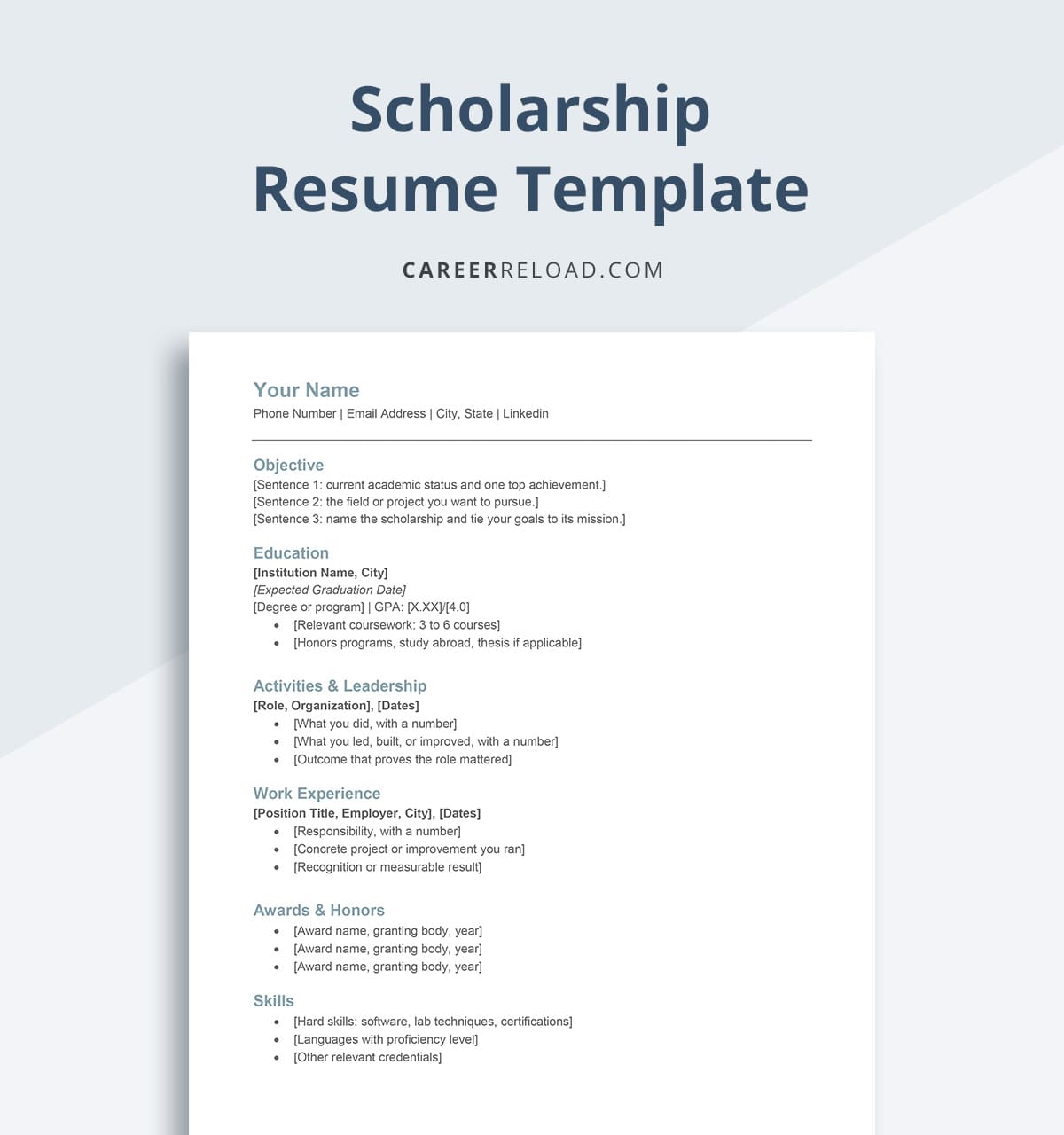
Build your resume for free with Career Reload’s resume builder. Create an optimized resume in no time. Creating a resume has never been this easy!
Common scholarship resume mistakes that cost students money
These are the patterns that make committees move on after 30 seconds.
- Recycling one resume for every application. A merit committee reads a resume tuned for community service and concludes the applicant did not pay attention. The objective and the order of sections should change for every scholarship.
- Padding to fill the page. Listing every club you attended once, every award from middle school, every “volunteer hour” your church counted toward confirmation. Empty space at the bottom is fine. Empty content is not.
- Skipping numbers. “Volunteered at the food bank” tells a committee nothing. Hours, dollars raised, people served, posts published, growth percentages. Every activity entry should carry one.
- Using passive language. “Was responsible for” and “was involved in” are throat-clearing. Open every bullet with an action verb (led, built, raised, taught, designed, organized, repaired, wrote, sold, recruited).
- Listing GPA below 3.0. If your GPA is under 3.0, leave it off the resume and let your essay address the academic record. The number cannot help; it can only hurt.
- Spelling and consistency errors. Inconsistent date formats (June 2024 in one section, 6/24 in another), random italics, two different fonts, the wrong scholarship name in the objective. Read the resume out loud once before you submit.
- Including protected categories. Religion, gender, age, marital status, sexual orientation, and a photo do not belong on a scholarship resume in the United States, Canada, the UK, or most of the EU. Even when including them is legal, it complicates the committee’s review and creates risk for the funder.
- Missing the deadline by a day. Most portals close at 11:59 PM in the donor’s time zone, not yours. A perfect resume submitted at 12:01 AM is not read.
How to tailor a scholarship resume for different award types
Tailoring is the single biggest lever for a higher hit rate. The body content stays mostly the same; the objective, ordering, and emphasis change.
| Scholarship type | What to lead with | What to expand | What to cut |
| Merit-based | Class rank, GPA, test scores, AP results | Honors programs, academic awards, named competitions | Long volunteer entries unless they show academic depth |
| Need-based | Hours worked, family responsibilities, first-gen status | Work experience, persistence in academics under workload | Decorative activities that read as resume padding |
| Leadership | Roles held, people led, outcomes delivered | Founded organizations, elected positions, measurable impact | Solo achievements with no team context |
| Service-oriented | Hours, beneficiaries served, length of commitment | Sustained involvement in one cause, named partner orgs | Drive-by volunteering with no follow-through |
| Field-specific | Coursework, projects, research, related skills | Lab work, internships, certifications, publications | Unrelated jobs and activities |
| Heritage or identity | Community membership and cultural involvement | Service inside the community, language, mentorship | Generic “diversity” claims with no record behind them |
| Local or civic club | Local schools, local employers, local volunteering | Specific community ties, named local organizations | Achievements that read as out-of-area unless tied back |
FAQ
How long should a scholarship resume be? One page. Always. Two-page resumes are for jobs and academic CVs. A scholarship committee reads dozens of applications per session and treats a longer resume as a sign the applicant cannot prioritize.
Can I include a scholarship resume if the application does not ask for one? Yes, in most cases, unless the instructions specifically say not to attach extra documents. A resume gives the committee a structured snapshot of your record that an essay cannot match. When in doubt, attach it as a single PDF labeled clearly.
What if I have no work experience at all? Replace the work section with activities, service, caregiving, or family responsibilities and treat them with the same rigor. A student who runs the household three nights a week while their parents work has work experience. The resume just has to name it.
Should I list my GPA if it is on a different scale? List it on whatever scale your school uses and label the scale (3.85/4.0, 92/100, 1.4 in the German system). Do not convert it; let the committee read it in context. If your school uses a non-standard scale, add a one-line note explaining it.
Do I need a different resume for each scholarship? You need a different objective for each scholarship and often a small reorder of sections. The body content can stay the same. The 10 minutes spent rewriting the objective are the highest-return time in the application.
Should I ask a teacher or counselor to review my scholarship resume? Yes. A second reader catches the typos and the missing context that you cannot see anymore. Ask one teacher in your field, one outside it, and your school’s counselor if possible. Three rounds of edits beat one.
Is it okay to use a template from a resume builder? Yes, as long as the final design is clean and easy to read, and you have removed every generic placeholder. Avoid heavy graphics, photos, sidebars, columns, and color blocks for scholarship use. Committees often print resumes in black and white.
A strong scholarship resume is the cheapest application improvement available. Spend an afternoon getting the structure right, then spend ten minutes per application tailoring the objective, and you will already be ahead of most applicants. Pair this with a focused essay and you have a real chance at funding.

Alex is a career expert who specializes in resume writing and job search strategies. He focuses on sharing real-world tips that make work and job search feel more manageable.
Others also read
How Do Temp Agencies Work? Your Questions Answered
Software Developer Resume Example to Land Your Dream Tech Job
Free ATS-Friendly Google Docs Resume Templates You Can Use Today
Top Trends Influencing Job Interviews
Bank Teller Resume Example and Writing Tips
How to List Work Experience on Your Resume (With Examples)
College Students: How to Prepare for Virtual Career Fairs
7 Top Job Interview Tips
You Might Also Like These Free Templates
Resume Template in Word Document
Google Docs Resume Format – Debbie
Free Template for Resume
Free Resume Form Template
2 Column ATS Resume Template
ATS Friendly Resume Format for Word – Lindsay
Cover Letter Template with Monogram
Professional Cover Letter Template
Free Modern Resume Template for Word
Free Job Application Tracker for Excel
Free Resume Template Download for Word – Farrah
Free ATS-Friendly Resume Template – Emily